Continuous sleepis a modernhabit, not an evolutionary constant, which helps explain why many of us still wake at 3am and wonder if something’s wrong. It might help to know that this is a deeply human experience.
For most of human history, a continuous eight-hour snooze was not the norm. Instead, people commonly slept in two shifts each night, often called a “first sleep” and “second sleep.”
Each of these sleeps lasted several hours, separated by a gap of wakefulness for an hour or more in the middle of the night. Historical records from Europe, Africa, Asia and beyond describe how, after nightfall,familieswould go to bed early, then wake around midnight for a while before returning to sleep until dawn.
Breaking the night into two parts probably changed how time felt. The quiet interval gave nights a clear middle, which can make long winter evenings feel less continuous and easier to manage.
Artificial lighting is behind the drastic change in human sleep patterns (Getty/iStock)
The midnight interval was not dead time; it was noticed time, which shapes how long nights are experienced. Some people would get up to tend to chores like stirring the fire or checking on animals. Others stayed in bed to pray or contemplate dreams they’d just had. Letters and diaries from pre-industrial times mention people using the quiet hours to read, write or even socialise quietly with family or neighbours. Many couples took advantage of this midnight wakefulness for intimacy.
Literature from as far back as ancient Greek poet Homer and Roman poet Virgil contains references to an “hour which terminates the first sleep,” indicating how commonplace the two-shift night was.
How we lost the ‘second sleep’
The disappearance of the second sleep happened over the past two centuries due to profound societal changes. Artificial lighting is one of them. In the 1700s and 1800s, first oil lamps, then gas lighting, and eventually electric light, began turning night into more usable waking time. Instead of going to bed shortly after sunset, people started staying up later into the evening under lamplight.
Biologically, bright light at night also shifted our internal clocks (our circadian rhythm) and made our bodies less inclined to wake after a few hours of sleep. Light timing matters. Ordinary “room” light before bedtime suppresses and delays melatonin, which pushes the onset of sleep later.
The Industrial Revolution transformed not just how people worked but how they slept. Factory schedules encouraged a single block of rest. By the early 20th century, the idea of eight uninterrupted hours had replaced the centuries-old rhythm of two sleeps.
In multi-week sleep studies that simulate long winter nights in darkness and remove clocks or evening light, people in lab studies often end up adopting two sleeps with a calm waking interval. A 2017 study of a Madagascan agricultural community without electricity found people still mostly slept in two segments, rising at about midnight.
Long, dark winters
Light sets our internal clock and influences how fast we feel time passing. When those cues fade, as in winter or under artificial lighting, we drift.
In winter, later and weaker morning light makes circadian alignment harder. Morning light is particularly important for regulating circadian rhythms because it contains a higher amount of blue light, which is the most effective wavelength for stimulating the body’s production of cortisol and suppressing melatonin.
In time-isolation labs and cave studies, people have lived for weeks without natural light or clocks, or even lived in constant darkness. Many people in these studies miscounted the passing of days, showing how easily time slips without light cues.
Similar distortions occur in the polar winter, where the absence of sunrise and sunset can make time feel suspended. People native to high latitudes, and long-term residents with stable routines, often cope better with polar light cycles than short-term visitors, but this varies by population and context. Residents adapt better when their community shares a regular daily schedule, for instance. And a 1993 study of Icelandic populations and their descendants who emigrated to Canada found these people showed unusually low winter seasonal affective disorder (SAD) rates. The study suggested genetics may help this population cope with the long Arctic winter.
Research from the Environmental Temporal Cognition Lab at Keele University, where I am the director, shows how strong this link between light, mood and time perception is. In 360-degree virtual reality, we matched UK and Sweden scenes for setting, light level cues, and time of day. Participants viewed six clips of about two minutes. They judged the two minute intervals as lasting longer in evening or low-light scenes compared with daytime or brighter scenes. The effect was strongest in those participants who reported low mood.
A new perspective on insomnia
Sleep clinicians note that brief awakenings are normal, often appearing at stage transitions, including near REM sleep, which is associated with vivid dreaming. What matters is how we respond.
The brain’s sense of duration is elastic: anxiety, boredom, or low light tend to make time stretch, while engagement and calm can compress it. Without that interval where you got up and did something or chatted with your partner, waking at 3am often makes time feel slow. In this context, attention focuses on time and the minutes that pass may seem longer.
Cognitive behavioural therapy for insomnia (CBT-I) advises people to leave bed after about 20 minutes awake, do a quiet activity in dim light such as reading, then return when sleepy.
Sleep experts also suggest covering the clock and letting go of time measurement when you’re struggling to sleep. A calm acceptance of wakefulness, paired with an understanding of how our minds perceive time, may be the surest way to rest again.
In 2018, Hannah Scott, a sleep researcher at Flinders University, waited for a woman to fall asleep.
This can take time when the subject is connected to equipment measuring brain activity, eye movement, heart rate and muscle activation. But about 30 minutes after the woman closed her eyes, Scott saw the tell-tale signs of sleep from the electroencephalogram, or EEG: a shift to lower-frequency brainwaves.
The woman progressed into deep sleep, and “was there for quite a while”, Scott said. Then, the woman suddenly woke up, saying she had to go to the bathroom. As Scott detached her from the machines, the participant apologized, saying she felt terrible she hadn’t been able to fall asleep yet.
“She was absolutely adamant that she hadn’t slept,” Scott said, who had just watched her sleeping.
When a person is sleeping, but doesn’t know they are, this is called sleep state misperception. If woken up, a person will say they were awake the whole time.
It’s a frequent issue in insomnia, said Matthew Reid, a neuroscientist and sleep researcher at Johns Hopkins School of Medicine. An insomniac may say they have barely slept, but when tested in a sleep lab, they might actually be sleeping a normal number of hours per night. This leads to a conundrum: how does someone feel rested when they are sleeping enough – but just not realizing it?
This experience, which afflicts a significant number of insomniacs, has had various names: paradoxical insomnia, subjective insomnia, sleep state misperception and, most recently, subjective-objective sleep discrepancy.
By any name, the phenomenon reveals that we don’t always know when we’re asleep or awake, and that our beliefs about sleep influence how rested we feel. At the same time, researchers are finding that people with paradoxical insomnia may not be entirely wrong; there may be something real that lies between sleeping and wakefulness.
‘We have just been overlooking this aspect of sleep.’ Illustration: Guardian Design
What is paradoxical insomnia?
Paradoxical insomnia is a subcategory of insomnia. People with it report that they only sleep a few hours a night and don’t feel rested. But sleep studies show they are getting more sleep than that – sometimes even a typical amount.
People with insomnia seem to suffer from straightforward problems: trouble falling asleep, staying asleep and getting enough sleep to feel rested. Their sleep issues make them tired during the day; they have difficulty concentrating, and feel irritable and grumpy.
But total sleep time doesn’t always differ by much between healthy sleepers and people with insomnia. On average, according to one meta-analysis, insomniacs sleep just 23 minutes less per night than healthy sleepers. If time asleep isn’t the whole story, what is?
Of course, some people need more sleep than others. But it turns out some people don’t perceive their sleep accurately. They do not seem to remember that they did sleep. They may sleep a full night, but not feel rested. These studies revealed that insomnia can be a more complex experience than it appears.
In 1959, French doctors first described a patient whose observed sleep time didn’t match up with how many hours she thought she slept. The doctors named the condition fausse insomnie or false insomnia, and believed it was caused by her being overly worried about sleep. Since then, many sleep doctors and researchers have noticed that insomniacs’ sleep complaints don’t always align with the amount of sleep they are observed to get.
Researchers don’t have a unified estimate of exactly how prevalent paradoxical insomnia is because it has multiple names. But it’s far from rare, Reid said. By some accounts, about half of people with insomnia sleep less than six hours a night, while the other half sleep more than six hours, an amount comparable to good sleepers’ sleep time.
Who experiences paradoxical insomnia?
Many people – even good sleepers – may think they’re still awake in the early stages of sleep. But people with paradoxical insomnia are more likely to think they’re awake after the first two hours. They are also more likely to report feeling awake during REM sleep, when almost all good sleepers will report accurately that they were sleeping. In serial awakening studies, people with insomnia who are woken up multiple times throughout the night will report being awake when they had actually been asleep more often than good sleepers.
Thomas Andrillon, a cognitive neuroscientist at the Paris Brain Institute, has a hunch that awareness during sleep is more nuanced than previously believed. In experiments about memory and learning during sleep, he would see someone sleep, confirmed by their brain activity in real time. Afterwards, they would insist they hadn’t slept. Andrillon realized he had experienced this himself, and that plenty of others did, too – such as his students, who would fall asleep in class, but have no idea they had drifted off.
Most people have gone through this, even if they’re not insomniacs. For instance, when I’m trying to sleep before an early morning flight, I usually feel like I haven’t even slept an hour. Yet I can recall a dream about, say, sleeping through my alarm, which tells me otherwise. I’ve sat next to a family member on an overnight flight who peacefully passes out, only to arrive at our destination and complain they didn’t sleep.
“You think you got zero sleep the entire night, and something reminds you that’s objectively not true, like somebody tells you: ‘Oh, you were snoring,’” Reid said.
Why does paradoxical insomnia occur?
Until recently, many researchers thought that people with paradoxical insomnia were incorrectly reporting their own experience. But brain imaging done by Andrillon and his colleagues is suggesting that insomniacs with discrepancies between their sleep and wake times might not be entirely wrong. Instead, they might be noticing a unique altered state of consciousness.
Sleep researchers determine someone is sleeping when they lose awareness of the world around them, and when their brain activity shifts to high-amplitude, low-frequency oscillations. EEG readouts will feature sleep signatures like slow waves and sleep spindles, or specific bursts in activity.
But commonly used observational techniques might miss the nuances of brain activity during the transition into sleep, or the moments between sleep stages, Andrillon said. The technology might not be sensitive enough to capture “wake-like” brain activity that could explain the feeling of being awake while sleeping. Andrillon said that when other researchers have studied deeper areas of the brain, they found signs of arousal, even when people seemed asleep.
“The fact that they look like they’re sleeping is true only at a superficial level,” Andrillon said. “When you dive a bit more in the details of the brain activity, you see signs of wakefulness that you will typically not see during normal or standard sleep.” Experts are now shifting to the term subjective-objective sleep discrepancy, or SOSD, rather than paradoxical insomnia or sleep state misperception.
In a study from March, in a group of more than 800 people with insomnia, 24% had subjective-objective sleep discrepancies. Andrillon and his colleagues found differences in the physiological profile between the two kinds of insomniacs. People with SOSD didn’t wake up very often, but when they did, their waking state was tainted with signatures of sleep, which could influence their judgment about not sleeping well or not having slept, he said. Conversely, the sleep of insomniacs without SOSD had wake-like features, meaning their sleep was of a lesser quality.
Are there solutions for paradoxical insomnia?
CBT-I, or cognitive behavioural therapy for insomnia, is a well-researched and effective way to improve sleeping habits. It seems to help people with SOSD, too. In a study from last year, Scott and colleagues found CBT-I had no difference in positive outcomes for people with regular insomnia, compared with those who had SOSD. Other studies have shown that CBT-I canimprove issues related to SOSD.
It won’t be useful to become overly worried about whether you’re getting the perfect amount of sleep, Scott said. There is an association between SOSD and anxious or worried thoughts about sleep, so try not to pile on additional worries. “People who have [SOSD] tend to have certain thoughts, very often involving rumination about worries of the day, worries of not sleeping, not being able to sleep,” Andrillon said.
Instead, a helpful tool for paradoxical insomnia could be a strategy called paradoxical intention, which encourages poor sleepers to stop trying so hard to sleep.
Previously, people who could not tell they were asleep were perceived to have flawed judgment. Actually, SOSD is a reminder that we don’t know everything about what it means to be asleep, and to know that we have slept. “We’re going back to it and seeing that it’s actually pretty real,” Andrillon said. “We have just been overlooking this aspect of sleep.”
Yogic sleep and bedtime meditations fixed my poor relationship with sleep says Emilie Lavinia. Here’s how to practice Yoga Nidra
According to new research from The Mental Health Foundation, in the past month alone, poor sleep has led to 48 per cent of UK adults feeling more angry or irritable, more stressed and overwhelmed, or more anxious. As someone who struggled with insomnia and poor quality sleep for years, the fact that almost half of the UK’s adult population sleeps poorly didn’t surprise me, but it did worry me.
In a culture that rarely switches off and leaves many of us lacking quality rest, we’re often looking for tools and tricks to help us recharge properly. A decent sleep yields better mental health, better focus and improved productivity and with The Mental Health Foundation’s same research showing that most of us only sleep well three nights a week, no wonder we’re all seeking solutions for better sleep.
Of course, social media and the wellness industry have encouraged us to obsess over hacks and tricks – creating “sleepmaxxing” protocols and exhaustive lists of sleep accessories. I am somewhat guilty of buying into the hype around sleep supplements and wearables, but honestly, the thing that helped me most when I was struggling to sleep wasn’t a daylight lamp or a silk sleep mask – it was the ancient practice of Yoga Nidra.
Yoga Nidra, or “yogic sleep” is a form of guided meditation that draws the mind into the twilight state between waking and sleeping. As sleep meditation has boomed and apps like Headspace have launched celebrity bedtime stories and sleepcasts, the “sleep yoga” category has become an overnight sensation – pun intended.
The practice helps to regulate the stress response by activating the parasympathetic nervous system (Getty Images)
What is Yoga Nidra?
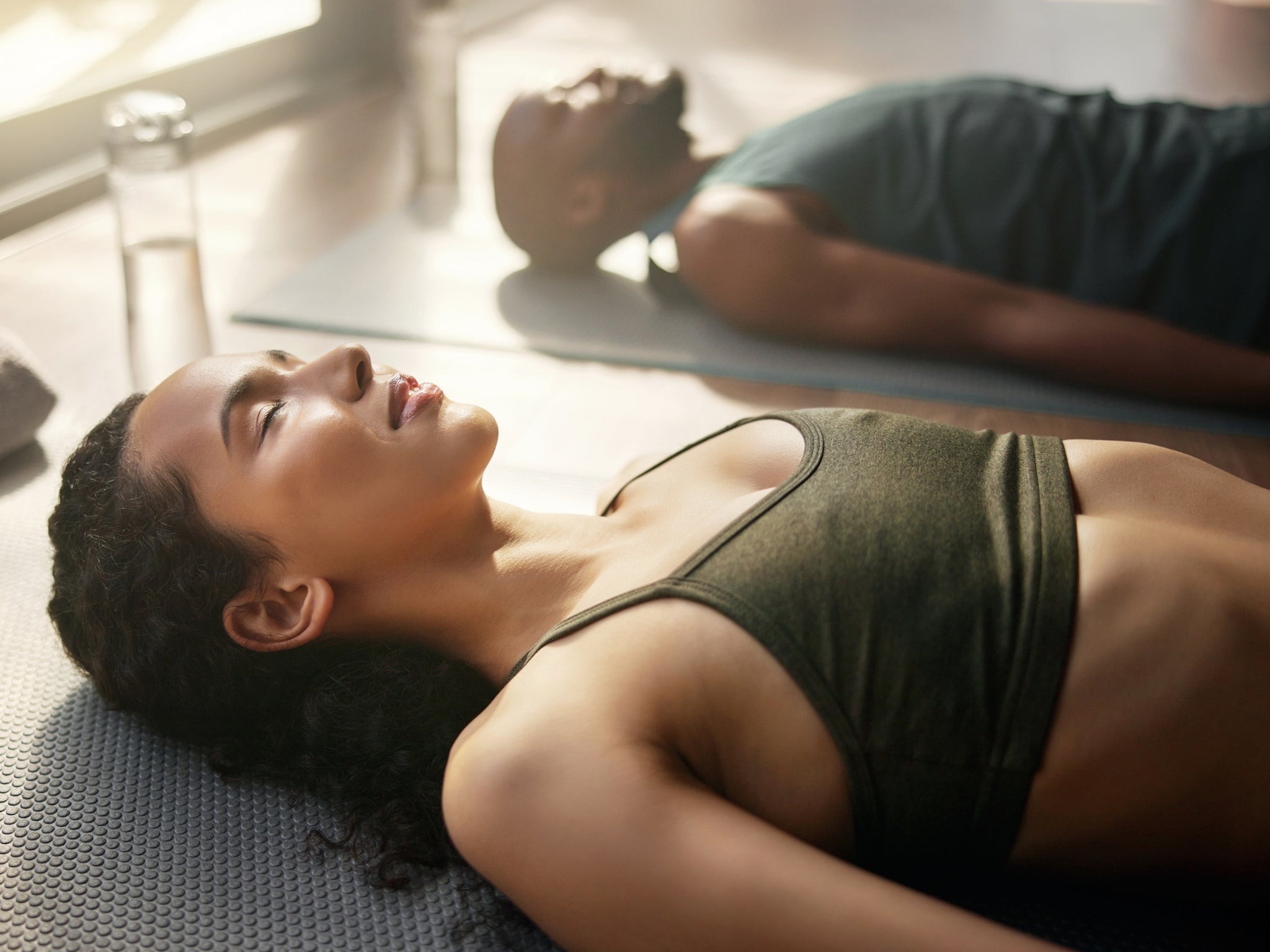
Yoga Nidra describes a kind of transcendental sleep or half-conscious meditation, a state between wakefulness and rest. The practice is akin to experiencing the peaceful rest and relaxation of sleep and dreaming, whilst awake. It’s rooted in ancient Hindu and Buddhist traditions and has been shaped by 1970s counter-culture experiments that reframed rest as a form of rebellion.
Kathryn McHarg, a yoga expert and Yoga Nidra teacher at BU Yoga, calls it “both a process and a state”.
She says: “Translated from Sanskrit Yoga Nidra means 'yogic sleep' but it’s not really about sleeping – although you may fall asleep which is completely fine. It is more about exploring the different states of consciousness, which occupy the alpha-theta border – that place between sleeping and waking.”
Performing Yoga Nidra involves practising pratyahara, or “withdrawal of the senses”, the fifth limb of Ashtanga yoga. The idea is that by going within and not moving – simply being – the individual can supposedly expand self-awareness. The bonus effect is that you feel incredibly relaxed and sleep comes much more easily.
In 1973, writer and yogi Dennis Boyes published Le Yoga du sommeil éveillé; méthode de relaxation, yoga nidra or The Yoga of Waking Sleep. This was the first known usage of the term as we know it. Later came yoga therapists and gurus perfecting the art, putting their own spin on it and creating the foundations of the practice that most of us recognise today.
Like any form of yoga, Yoga Nidra is taught by all kinds of teachers. Some blend the practice with instructions for more far-out concepts like lucid dreaming or astral projection (both of which I have tried and enjoyed) whereas others focus on using the deep breathing and full-body check-in to access the practical aspects of relaxation – I find the latter more useful day-to-day.
Unlike other forms of yoga – and perhaps this is the secret to its success in the UK – Yoga Nidra doesn’t require any movement. Instead, it’s a combination of focus and breathing, essentially a mental process of checking in and meditating while lying still.
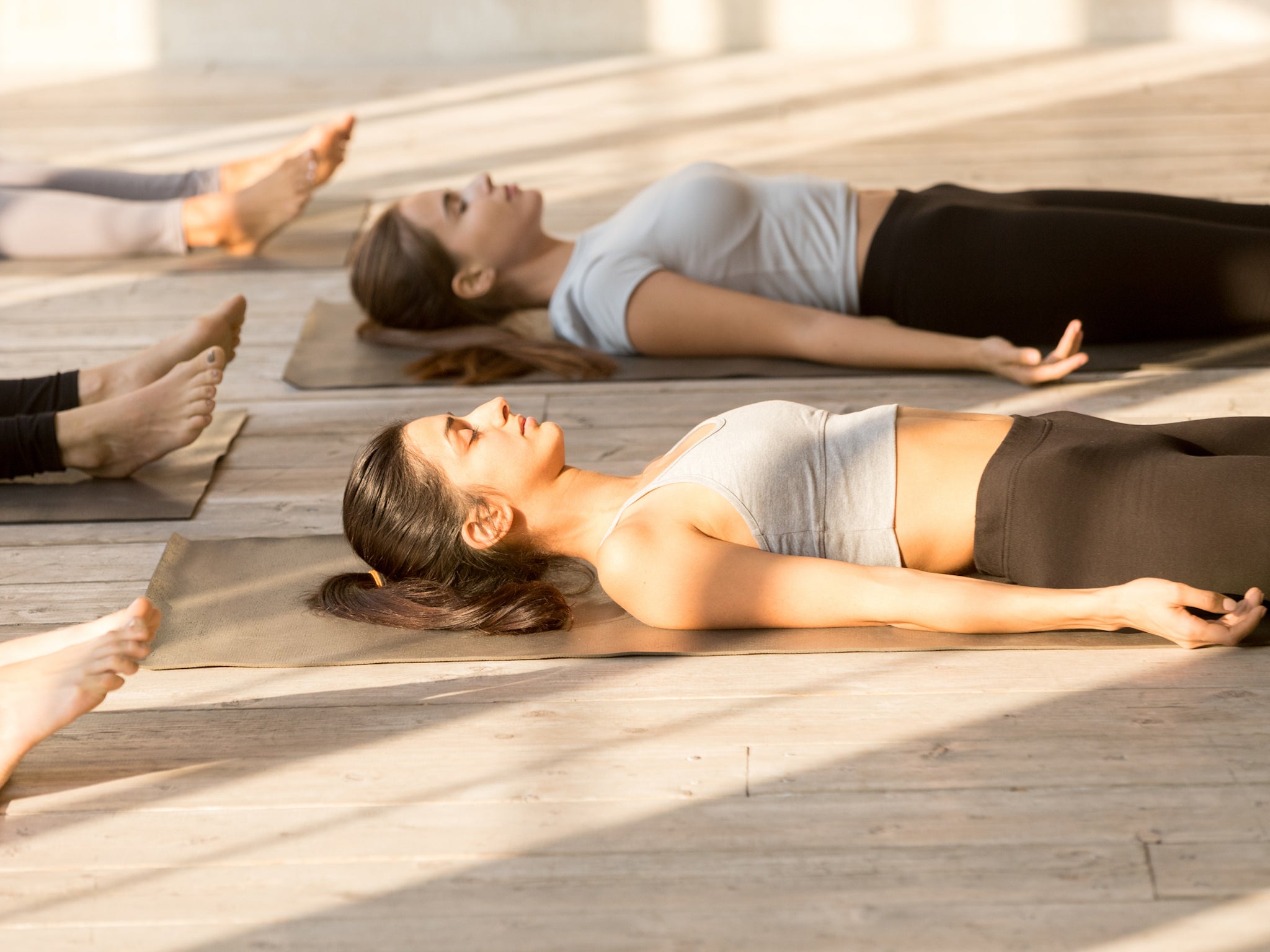
Libby Stevenson, Head of Yoga for Harley Street at Home, describes it as a deeply accessible practice. “It takes about 15-20 minutes and it involves lying down comfortably on a bed, yoga mat or carpet,” she says. “Then you’ll listen to a guided relaxation which involves breath and body awareness but with this practice, there is no physical movement.”
“There are different ways to lie down depending on the physical limitations of the participants but generally, participants lie flat on their back, or for anyone with lower back issues, with cushions under their knees,” she adds.
“Ideally, the participant is in a room where they will not be disturbed. They might want to have a blanket cover them because as the body relaxes, it also cools down. Then a guided instruction on how to relax the body begins. It starts with gentle isometric stretching and leads to stillness and it’s impossible to do it wrong.”
One study linked the practice of Yoga Nidra to increased endogenous dopamine release in the ventral striatum, a region associated with motivation and pleasure (Getty Images) What happens during Yoga Nidra?
“There are various steps in a Yoga Nidra practice,” McHarg explains. “Such as the 'arrival' phase. Then there could be opposites, images, free flow and then a 'return'. Different teachers will add in or take out stages of this process depending on their training. I tend to gauge this based on my yogis and depending on what the intention of the practice is.”
At the start of a Yoga Nidra practice, the brain is typically in an active beta wave frequency – an alert, problem-solving mode. This is typically the mode we try to move out of when using yoga and meditation as tools.
As relaxation deepens, brain activity slows into alpha waves, bridging conscious thought with the subconscious. In this state, serotonin is released, bringing calm and stillness. With time, delta waves emerge, mirroring the deep restorative stages of sleep. The difference is that in Yoga Nidra, we remain awake, aware and conscious throughout.
This sequence produces measurable physiological effects. One study linked the practice of Yoga Nidra to increased endogenous dopamine release in the ventral striatum, a region associated with motivation and pleasure. Another found improvements in heart-rate variability – a key indicator of a healthy autonomic nervous system. A third observed better sleep efficiency, shorter sleep-onset latency and reduced time in bed after just four weeks of Yoga Nidra compared to progressive muscle relaxation.
On a biochemical level, the practice helps to regulate the stress response by activating the parasympathetic nervous system. During slow, controlled breathing, the vagus nerve is stimulated which lowers heart rate and blood pressure, enhancing digestion and signalling to the body that it’s safe to rest.
Studies suggest that regular yogic breathing can reduce tension and anxiety, while autonomic symptoms such as headache, chest pain, palpitations and abdominal discomfort respond well too. For me, a racing anxious mind prevented me from sleeping well for many years. I tried plenty of different sleep aids but the thing that made the most difference and allowed me to drop into a relaxed state with a clear mind and then drift off to sleep was my nightly Yoga Nidra practice.
A busy mind is the most common barrier to sleep. Research shows that when we try to block intrusive thoughts, they rebound more strongly. “We need to learn to notice and let go of thoughts, rather than trying to control them,” says Guy Meadows, a sleep physiologist and founder of Sleep School.
“The first step is to anchor the attention in the present moment by noticing the movement of the breath. Then when the mind wanders, which it will, you acknowledge this fact before returning your attention back onto the breath. Brain imaging research shows that repeatedly noticing the breath and letting go of thoughts, strengthens a part of the brain responsible for calming down mental chatter.”
Yoga Nidra can both soothe the nervous system and quiet anxious chatter before bed (Getty Images)
The benefits of Yoga Nidra
The primary benefit of Yoga Nidra is deep relaxation. As the body relaxes, tension releases while the mind stays gently focused on the guidance. The combination is profoundly soothing to the nervous system.
“We relax the body by focusing the mind on a part of it: the feet, the lower leg, the upper leg, the hips, and so on all the way up to the face and head. We send each part of the body a mental message to relax. It’s that simple. But so effective,” says Stevenson.
This mindful body scan also invites emotional clarity. Practitioners often experience gratitude, and research shows that consciously reflecting on what we’re grateful for creates a more positive mindset, which in turn helps regulate the nervous system.
“Taking gratitude can be as easy as spending a few minutes at the end of the day in bed to think about the events, people or places that you’re grateful for in your life that day,” says Meadows. “Whatever comes to mind, see if you can clearly identify why it is that you are grateful for it and pause to notice how the feeling of appreciation feels.”
There’s no right or wrong way to practise, and anyone can do it. I found that when I started a few years ago, my mind would wander. I also wasn’t very good at bringing any gratitude into my practice. These days, I do my 10-20 minute practice, breathe deeply, access those feelings of gratitude almost instantaneously and fall asleep straight afterwards. It just takes consistency.
“Absolutely anyone and everyone can do Yoga Nidra,” says Stevenson. “From children to the elderly, disabled and able-bodied people, those who are bed-bound, pregnant people and especially anyone experiencing feelings of overwhelm, hot flashes, night sweats and panic attacks. The breathing technique is what makes it so effective for those experiencing anxiety.”
The approach has been used to help soldiers cope with post-traumatic stress disorder, acting as a bridge between body-based therapies and cognitive resilience. However, McHarg advises that it’s best to consult with a teacher before practicing if you are experiencing severe anxiety.
“Some of the benefits of Yoga Nidra are greater awareness or interoception of the physical body and greater focus. The only real contraindications here are psychosis and schizophrenia. If you are experiencing these conditions Yoga Nidra would be unhelpful. And if you are living with trauma or PTSD it’s important to discuss it with your teacher. Whilst general stress, and worry are everyday issues, severe anxiety can require specialist support,” she says.
Why practice sleep yoga?
The surge in Yoga Nidra’s popularity speaks to both science and need. Experts suggest the UK is nearing a wellbeing crisis point and that our chronic stress levels are becoming dangerous. A nervous system locked in fight-or-flight mode contributes to burnout, insomnia and inflammation but practices like Yoga Nidra directly counteract this by training the brain and body to downshift.
“Sleep is a trainable skill that you can learn to be better at, especially during times of stress,” says Meadows. “But no method works in isolation, you also need to practice good sleep hygiene.”
Ironically, perfect sleep and a zen disposition during waking hours doesn’t happen overnight. It took me several months of consistent bedtimes and waking times, healthy habits and nightly Yoga Nidra practice to get into a groove. Now, after several years, I can use Yoga Nidra whenever I feel stressed, if I’m travelling between time zones or if I want to nap during day.
The best place to start is in a class or with a qualified teacher guiding you via a recording. But you don’t have to pay for an expensive app. There are plenty of brilliant teachers to be found on Instagram and free Yoga Nidra sessions on Spotify and YouTube.
The results can be tangible: lower blood pressure, steadier mood, sharper focus and, perhaps most importantly, the ability to let go and switch off. Between waking and rest lies a space most of us rarely reach – Yoga Nidra invites us back there and the science shows it’s a place well worth visiting for improved health and healing.
Like depression, insomnia used to be treated as a symptom of “something else.”Not anymore.At this year’s national sleep meetings in Denver, it became clearer how big a national and international problem insomnia is – as well as how to fix it.
As insomnia researcherCharles Morin pointed out, the distinction between “primary” and “secondary” insomnia is gone.Insomnia afflicts people – and many of the people around them – through effects that affect much of modern life.
If you don’t feel you get enough sleep, there can be hell to pay.Here are a few examples:
Economic – people with insomnia are unhappy, irritable, more prone to accidents and errors of judgment, and less productive.They are also less helpful to their colleagues.Though the problem is worst at the bottom of the economic scale, with people trying to commute and work to three part-time jobs choosing between time asleep or time for work and family,CEOs are also hit.The reason?International travel and 24/7 schedules.Humans are not machines.We just try to act like we are.One of the biggest “trends” for CEOs are executive trainers who specialize in “getting people sleep” and overcoming jet lag. It’s not just shift workers now.Biological clocks have arrived in the executive suite.
Medical – People who get sick – whether it’s colds or cancers – sleep less effectively, and take longer to regenerate themselves.A big trend in insomnia research is the realization of how much insomnia affects cardiovascular disease, through more hypertension and heart attacks.As is often the case with insomnia, there is an endlessly increasing dialectic – more medical problems make for more insomnia, and more insomnia makes for more medical problems.
Psychiatric – Ever since Boris Angst in Zurich showed how a third of insomniacs eventually become depressed, people have been paying attention. According to Morin, insomnia doubles the rate of depression, a finding consistent throughout the world.Tom Wehr in the US showed two decades ago he could manipulate mania or depression by changing people’s sleep times.If you want to see schizophrenia burst out in its full, naked form, observe people who consistently can’t sleep.
Military – sleep in armies and navies gets too little attention.Soldiers in combat zones often sleep poorly.Ongoing research by the US military demonstrates how this sets up soldiers to make potentially catastrophic errors, both military and moral.Plagued by traumatic brain injury and post-traumatic stress disorder, the American military now recognizes it has huge sleep problems.Insomnia is the thread that runs through most of them.
Sleep deprive an animal long enough and it dies.Those experiments have not been done in people – very thankfully.But mess up rest and all kinds of bad things happen, to ourselves and our communities.Fortunately, the right treatments work.
Treatment
Worldwide, the most common treatment for insomnia is pills.The most effective treatment is cognitive-behavioural techniques for insomnia, or CBTi.This mismatch leads to much mayhem.
Looking at the data of Dan Kripke, an emeritus professor at the University of California, San Diego, regular sleeping pill use is associated with a mortality odds ratio of five – five times the death among people using sleeping pills as compared with controls.Other studies have found somewhat lesser fatality numbers, but they remain scary.People regularly using sleeping pills have higher death rates in cardiovascular disease; accidents; even cancer.
The CBTi approach generally starts with behavioural techniques.That means teaching people about biological clocks and how to sleep, something many in the internet age have forgotten.Machines can go full blast all day.We can’t. We need rest like we need food.Teaching people the basic principles of sleep is now gaining more attention, one of the reasons I started sleepuniversity.org.
Following behavioural techniques, people learn cognitive ones – how their thinking about sleep changes their sleep.Combining behavioural with cognitive techniques, people learn how to approach sleep in terms of solutions, not just problems.They recognize that staying in bed when you can’t sleep doesn’t help. They learn that not every night of sleep is not perfect.They begin to see how body clocks influence so much of their lives.They figure out ways to think differently, not just about sleep, but about health in general.
CBTi is now used all over the world in hundreds of different configurations.Many companies are putting it out on the web.Manuals short and long exist by the truckload.It’s not just effective, it’s cheap.
The profit margin on sleeping pills is much, much greater.
The Future
Insomnia researchers, like depression researchers before them, are trying to subtype different kinds of insomnia.They’re trying to figure out how it occurs,including the realization that in insomnia not all of the brain is “asleep” when people think they’re sleeping.
Yet the basic teaching is simple.We need sleep to live.To sleep well we have to treat our bodies as bodies, not machines.And for the 10% of the population that already has bad insomnia, the most safe and effective treatments don’t involve drugs.
From weighted blankets to the right lightbulbs, the products in your bedroom can make a world of difference when it’s time to turn in
Americans can’t sleep. Abouta thirdof Americans struggle with some form of insomnia, something experts attribute to stress, depression, screen use before bed, and substances such as caffeine and alcohol. And getting a good night’s rest isbig business, with Americans spending billions each year on supplements, sleep-tracking devices and high-end mattresses.
What actually works? The Guardian asked a range of sleep experts – two psychologists, a chiropractor and a sleep podcaster – for advice on getting a good night’s sleep and the mattresses, linens and sleep accessories they swear by.
Illustration: maystra/Getty Images
Set a consistent bedtime routine
“I have had insomnia on and off since I was a kid,” said Drew Ackerman, creator and host of the popular Sleep With Me podcast. “The way I manage it now is just having a solid bedtime routine. It gives me something nice to look forward to instead of [bedtime] being something to dread.”
Ackerman said he likes to journal ($29.95), meditate, stretch out with a foam roller ($14.68) and read fiction at night. He likes the Insight Timer app (free or $60 a year for the premium version) for its broad selection of meditations.
Andrew Bang, an Ohio-based chiropractor who works with the Cleveland Clinic’s sleep clinic, said he encourages patients to do yoga or light stretching before bed. “We want you to go to bed as loose as possible so you don’t stiffen and tighten up during your sleep,” he said.
Keep your bedroom quiet and dark, and avoid blue light
“I really stress that the bedroom should be like an oasis,” said Janet Kennedy, a sleep therapist. “It’s a place where you feel like you get to go at the end of the night.”
Kennedy said she uses a Yogasleep Dohm sound machine ($54.99), popular in therapists offices, and the Manta sleep mask ($39). “It stays put, it doesn’t put pressure on your eyes, and it is truly comfortable,” she said, adding: “It’s also really helpful for sleeping with a partner who doesn’t have the exact same schedule as you.”
He said he and wife also use a Hatch sunrise alarm clock ($169.99). “My wife loves it because it’s on her side. It mimics sunlight, birds chirping and crickets at night.”
There’s no perfect mattress – just pick one with a good return policy
“You spend a third of your life laying down, so a bad mattress can aggravate [injuries] or create new ones,” Bang said, adding that medium-firm is typically the most recommended firmness – “although there’s no industry standard”.
One other reason to start with a mattress on the firmer side? “You can’t take softness away,” he said. “If a mattress feels too firm, you can always add a mattress topper [$295].”
The only way to know if a mattress is right for you is to sleep on it for a month, he said. “Look for a mattress company that has a good return policy,” he said. “Because no matter what mattress you’re getting, you need about 30 days for your body to adapt to what is new.”
Prather, who sleeps on a Simmons Beautyrest Classic ($1,219.99 for a queen bed), suggested looking into mattresses with cooling properties. “Core body temperature has to drop as we go into sleep, and some of these mattresses can help with that,” he said.
Ackerman, who in a past life sold mattresses on Craigslist, uses the Helix Dusk ($1,099 for a queen), which the company provided him, but said that no mattress is a panacea to insomnia. “It’s just one piece of the puzzle,” he said.
Treat yourself to nice, cooling linens and consider weighted blankets
“I’m a huge proponent of an old-fashioned, crisp, cotton percale sheet,” said Kennedy, who said her favourite sheets are a discontinued Martha Stewart for Macy’s set. “I haven’t found a replacement yet, partly because they last a long time!” she said. “It makes me feel like I’m sleeping at my grandma’s house.” She also uses the Ice Cube pillow ($89.99) from Pillow Cube, which specializes in support for side sleepers, and an enormous blanket ($126.65) from Big Blanket Co. (“It actually fits over a king-size bed whereas a lot of king-size blankets are skimpy.”)
Ackerman, also a fan of crisp, cotton sheets, likes the weighted comforter ($308) from Baloo Living.“It feels like you have a ton of blankets on you but it’s still cool,” he said. “It’s like you’ve been tucked in.”
Illustration: Nataliia Nesterenko/Getty Images
There is some benefit to sleep trackers – unless they stress you out
“As a sleep scientist, I am always interested in new technologies that emerge to measure sleep,” said Prather, an early adopter of the Oura ring, a popular sleep tracker.
Ackerman said he currently uses theApple Watch (starting at $249) sleep tracker. “It is good for finding patterns,” he said, “over a longer term to be like, ‘What’s really going on here?’ versus just reacting to it after one night.”
Bang said they can provide helpful clues to people struggling with poor sleep, adding that there are several low-priced apps on the market, including Sleep Cycle and SleepScore. “The downside is that these aren’t as sensitive and may not give the whole picture,” he said, adding that devices such as Whoop (starting at $149), the Oura Ring ($349) and even most smart watches can give more specific personalized data. “The gold standard is to get a sleep study that would be prescribed by a medical physician.”
“I typically caution against Oura rings for people who are anxious about sleep,” said Kennedy. She said while they can help some users recognize correlations between, say, drinking too much and getting a bad night’s sleep, in other cases “if you’re trying to hack your sleep, it creates a lot of frustration and anxiety,” she said.
Danielle Renwick is senior editor, US partnerships at the Guardian.
 Artificial lighting is behind the drastic change in human sleep patterns (Getty/iStock)