Showing posts with label breathing. Show all posts

Saturday, 15 August 2026

Waking up exhausted? A hidden sleep disorder may be hijacking your rest

From businesstimes.com.sg

Experts tell us why women with insomnia should be screened for upper airway resistance syndrome 

[SINGAPORE] Despite getting sufficient hours of shut-eye every night, LT would wake up feeling tired and with a mild headache. During sleep, the 29-year-old software engineer would also grind her teeth.

She tried to improve her sleep by wearing mouth tape, nasal strips and has even had a masseter Botox injection, which delivered the drug into the large chewing muscle on the jaw to relieve clenching and teeth grinding, or bruxism.

But nothing worked until she saw a sleep specialist who diagnosed her with upper airway resistance syndrome (UARS).

Many are familiar with obstructive sleep apnoea (OSA), a medical condition in which the airway is completely blocked and breathing repeatedly stops and starts during sleep.

But few are aware of UARS, a form of sleep disorder involving mild airway narrowing and micro-awakenings driven by extra breathing effort.

Dr Lee Chuen Peng, a pulmonologist, sleep physician and intensivist consultant at O2 Lung Centre and medical director of O2 SleepWell Laboratory, says: “Your brain notices the struggle and wakes you up just enough to fix it, over and over throughout the night.

“You rarely remember these wake-ups, but they stop you from getting a deep, restful sleep. Your oxygen level stays fine, and your airway never fully blocks – which is why it so often gets missed.”

Upper airway resistance syndrome is more common in women than men. PHOTO: PEXELS

Dr Leow Leong Chai, senior consultant at Singapore General Hospital’s Department of Respiratory & Critical Care Medicine and director of its sleep centre, says UARS is much less common than OSA.

“Data from a local study showed the prevalence of moderate to severe OSA in about one in three adults,” he says. “UARS is thought to be about 10 times less common.”

While OSA patients are predominantly male in the ratio of three or four to one, UARS is about three times more prevalent in women. “Because it’s so often misdiagnosed or missed entirely, the real number is probably higher,” adds Dr Lee.

What’s going on?

Women with UARS are typically younger than the average OSA patient, slim or of average weight, and may have a smaller jaw or narrower airway.

They tend to grind their teeth, suffer from headaches and brain fog and may also be described as anxious, depressed, or having fibromyalgia or irritable bowel syndrome (IBS).

In general, these patients – mostly women – feel very exhausted, says Dr Kenny Pang, who treated LT. He is an ear, nose and throat (ENT) specialist who focuses on sleep medicine and surgery at Asia Sleep Centre.

“The paradox is that while most of them are tired and exhausted, many have insomnia or sleeplessness.”

Dr Leow adds that not infrequently, these patients have sought medical attention before, and their symptoms have been dismissed as insomnia or stress-related.

The cause

The primary problem is nasal obstruction, says Dr Pang, whose UARS patients make up 20 to 25 per cent of his sleep practice.

The narrowing of the upper airway during sleep can have anatomical reasons such as facial structure, jaw positioning or a deviated nasal septum.

There may also be physiological causes, including the relaxation of throat muscles during sleep, inflammation or swelling of airway tissues, enlarged tonsils or adenoids and chronic nasal congestion.
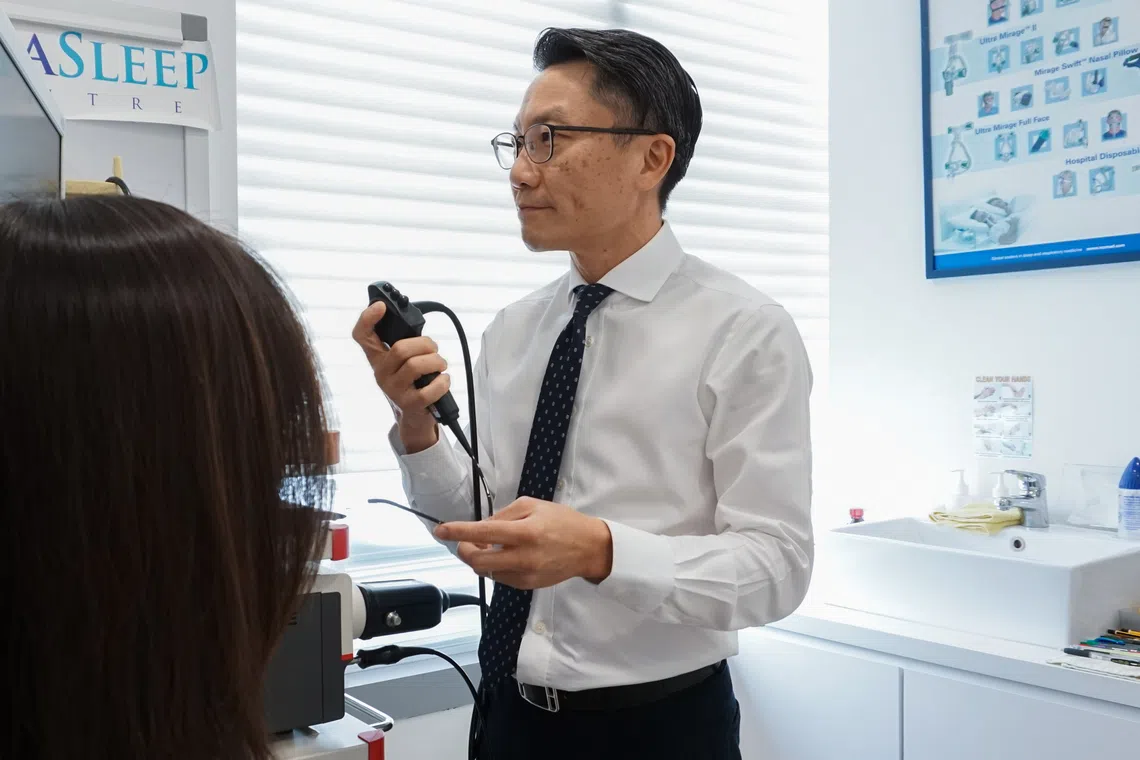
Dr Kenny Pang of the Asia Sleep Centre says the primary problem behind UARS is nasal obstruction. He is pictured conducting a naso-endoscopy. PHOTO: ASIA SLEEP CENTRE

Unlike OSA patients – many of whom are able to sleep through pauses in breathing – UARS sufferers have low arousal thresholds. This means their brains detect even a little collapsing of their airways, causing them to bite down or clench their jaws, says Dr Pang.

This reflex mechanism keeps the upper airway muscles open, but leaves the patient with neckaches and headaches from biting down hard every night.

The patient also becomes tired and exhausted because of the broken sleep. “Moreover, because of the frequent biting and teeth grinding, the patient develops jaw joint problems,” he says, referring to the temporomandibular joint disorder.

The health risks

Unlike OSA, which carries a risk of hypertension, strokes, heart attacks and sudden death, UARS causes impairment to sleep quality, mood and daytime functioning, notes Dr Leow.

Sufferers are also at a higher risk of depression.

This is because chronic broken sleep feeds anxiety and low mood, says Dr Lee. The lack of deep sleep also robs the sufferer of the ability to consolidate memory, so thinking becomes foggy and slow.

Fragmented sleep also worsens other conditions, including pain, chronic fatigue and IBS.

In women, the health risks are amplified during perimenopause and menopause as hormone levels fall.

Drops in progesterone – which naturally helps keep the airway open and breathing steady – makes the throat more likely to narrow during sleep. A fall in oestrogen, which supports airway health and reduces inflammation, can also lead to nasal congestion and airway irritation, making snoring and breathing problems during sleep more likely.

Hot flushes and night sweats break sleep further, while the heart and blood vessel risks from poor sleep become more serious with age, says Dr Lee.

“A woman who was managing okay with UARS in her 30s may suddenly feel dramatically worse in her 40s and 50s, and no one connects it to her breathing.”

Indeed, Dr Leow points out that studies have shown a stark increase in prevalence of sleep disordered breathing – from snoring to UARS and OSA – after menopause.

“That’s why we must be vigilant about screening for this condition in women who present with poor sleep quality or insomnia, instead of blaming it on hormonal changes or stress.”

The diagnosis

The gold standard for diagnosing UARS is by having the patient undergo an overnight sleep study in a clinical setting that monitors and records physiological parameters to analyse sleep patterns, says Dr Leow.

In UARS patients, their Apnoea-Hypopnea Index – which measures the average number of breathing pauses (apnoeas) and shallow breathing events (hypopnoeas) in each hour of sleep – remain normal.

So sleep specialists look specifically for the tiny wake-up moments caused by increased breathing effort, called respiratory related arousals (RERAs).

“The key findings are normal oxygen levels all night and a low or normal standard breathing score, but repeated micro-arousals tied to breathing effort plus daytime symptoms such as exhaustion and brain fog,” says Dr Lee.

Dr Pang, however, has been using the WatchPat – a wristwatch-like sleep test used at home – to measure patients’ respiratory disturbance index (RDI). High RDI readings are indicative of high RERAs, which cause tiredness, sleep fragmentation and sleep disruption.

The treatment

To treat the condition, nasal airflow must be optimised, so any nasal congestion has to be dealt with first. “Then UARS can be treated with continuous positive airway pressure therapy, oral appliances or positional sleep therapy devices,” says Dr Leow.

At Dr Pang’s practice, antihistamines and nasal sprays are first prescribed to see if they relieve nasal congestion and allergies.

If they do not, he opens the nasal passage by performing nasal turbinates reduction – a procedure to shrink enlarged bony structures (turbinates) inside the nose – and straighten the septum if it is deviated. These were the surgeries LT underwent.

A dentist can also give the patient a splint or mouth guard to protect her teeth and temporomandibular joint and administer masseter Botox.

Properly treated, patients feel they can breathe so much better through their nose and have less bruxism.

“My sleep quality has improved significantly,” says LT. “Now, I wake up feeling refreshed and the headaches are gone.”

Women also commonly report their energy returning and are able to get through the day “without crashing”, says Dr Lee.

In addition, better sleep lifts their mood, improves their memory and leads to clearer thinking, fewer headaches, less pain and calmer digestion.

“For many women, just getting the diagnosis after years of being dismissed is a turning point,” he says. “Treatment gives them their life back.”


https://www.businesstimes.com.sg/lifestyle/travel-wellness/waking-exhausted-hidden-sleep-disorder-may-be-hijacking-your-rest

Monday, 23 March 2026

Insomnia: according to Harvard, this yoga ritual could replace sleeping pills

From futura-sciences.com

People with chronic insomnia lie awake cycling through the same nightly bind: another hour staring at the ceiling, or another pill. Harvard Medical School research points to a third option hiding in plain sight 


Two decades of clinical trials

At Harvard Medical School, Dr. Sat Bir Singh Khalsa has spent more than two decades running clinical trials, where he tests yoga as a treatment for sleep disorders. Through his role as Director of Yoga Research at the Kundalini Research Institute, he conducts this work within the Division of Sleep and Circadian Disorders at Brigham and Women’s Hospital — one of the most rigorous sleep research programs in the country.

His 2021 randomized controlled trial, published in the Journal of Clinical Sleep Medicine, tested an eight week Kundalini yoga program against an active sleep hygiene comparison in adults with chronic sleep onset insomnia. Yoga produced measurable improvements in sleep efficiency, total sleep time, and insomnia severity. Those gains held at a six month follow-up.

Building on that success, a 2004 study published in Applied Psychophysiology and Biofeedback tracked chronic insomnia patients through an eight-week daily yoga program that they learned in a single session and then practiced independently at home. Across every key measure, the results were consistent: sleep efficiency improved, total sleep time increased, and participants fell asleep faster.

Why yoga targets insomnia differently

Most sleep medications suppress the nervous system to induce unconsciousness. Yoga works through a different mechanism entirely. Chronic insomnia involves elevated cognitive and physiological arousal. Under chronic stress, cortisol and adrenaline keep the nervous system primed for action even as the body strains to stand down.

Yoga addresses that arousal directly. Controlled breathing activates the parasympathetic nervous system, lowering heart rate and reducing cortisol. Held postures build body awareness and interrupt the ruminative thought patterns that delay sleep onset. Where most sleep interventions mask symptoms, Khalsa’s approach targets the underlying causes and the trial results reflected that. Improvements persisted for six months after the intervention ended.

In separate school based research, Khalsa found that adolescents who practiced yoga regularly showed improvements in sleep onset and measurable reductions in stress related symptoms, evidence that the physiological effects extend across age groups, not just clinical insomnia populations.

The technique researchers highlight

SETU-BANDHASAANA-1 (1)
© Freepik

Among the specific practices Khalsa’s protocols use, pranayama — controlled breathing — consistently appears as a core component. The technique involves deliberate regulation of breath rate and depth, and in doing so directly influences the autonomic nervous system. In clinical settings, participants learned it in a single session and then practiced independently at home.

Beyond breathwork, bridge pose — a gentle backbend performed lying down — features in several Kundalini yoga sleep protocols. The posture encourages diaphragmatic breathing and parasympathetic activation, the physiological state the body needs to transition into sleep.

Where the evidence stops

Khalsa’s trials compared yoga to sleep hygiene and relaxation practices, not to pharmaceutical sleep aids directly. As a result, the claim that yoga outperforms sleeping pills is not supported by his published work. What the research does establish, however, is that a self-administered, low cost yoga practice produces clinically meaningful improvements in chronic insomnia that persist over time, without the dependency risks or next day cognitive effects associated with sedative hypnotics.

Cognitive behavioural therapy for insomnia remains the clinical standard of care. Yet Khalsa pairs yoga with CBT in several protocols, where the two approaches reinforce each other, yoga reducing physiological arousal while CBT targets the thought patterns that sustain it.

Participants learned the practice in a single session, then followed it daily for eight weeks, and still showed improvements six months after the trial ended. A sedative addresses one night. A practice that rewires the nervous system’s response to sleep addresses every night that follows.

https://www.futura-sciences.com/en/insomnia-according-to-harvard-this-yoga-ritual-could-replace-sleeping-pills_28199/

Thursday, 18 December 2025

Struggling to Sleep? Experts Say These 10 Common Behaviours Could Be the Real Culprits

From realsimple.com

Some of these behaviours might feel good, but restful sleep is more important 

A good night's sleep is the absolute best form of self-care. But several common night time behaviours may be wrecking your ability to fall asleep, stay asleep, and consistently get quality rest. Each habit impacts people differently, and some might unexpectedly help you stay asleep. (If you swear scrolling your phone helps you sleep better, don't stress over it.) However, if you’re struggling with a bout of poor sleep, start by eliminating every sleep habit on this list that applies, then add them back one-by-one to find the culprit. We spoke with sleep experts about the worst sleeping habits and how to get back on track.

01of 10

Phone Usage

Several experts agree that it’s a good idea to limit your phone use before bed. “Most people are on their phones or watching late at night, which suppresses melatonin,” sleep expert Olivia Arezzolo explains. This can make it hard for people to fall and stay asleep.

Andrea López-Yianilos, PsyD, says to power down all devices and do something else at least an hour before bed. If you have to be on your phone, you could try blue light blocking glasses or the "Night Shift" (on iPhone), which warms the colours on the display. These steps could reduce the impact of blue light, although studies are inconclusive.

02of 10

Eating or Drinking

Eating or drinking within three hours before bed can make for a restless night. And there’s one beverage (the nightcap) that seems like it helps when it actually doesn’t.

That glass of wine might make you feel drowsy, but if you drink it right before bed, it could mess with your sleep quality by disrupting REM sleep. "When alcohol metabolizes, you get dehydrated," López-Yianilos explains, "So you'll have more fitful sleep."

When it comes to eating, moderation is key. Too much or too little food before bed could impact your sleep quality. Try to schedule meals at least three hours before bedtime, and if you get hungry late at night, stick to a small yet filling snack, like nut butter on crackers, López-Yianilos suggests.

03of 10

Exercising

Avoid working out too close to bedtime because exercise raises your body temperature, López-Yianilos explains, and your body temperature should naturally dip as you get ready to sleep.

However, this doesn’t mean never exercising. Just 30 minutes of moderate-intensity aerobic activity during the day can help you sleep better.

04of 10

Not Winding Down

This bad sleep habit is more about not having a habit at all. We should all set aside some time before bed to wind down. “If you are working, scrolling, cleaning, and planning until the second you get into bed, you can expect to have a hard time falling asleep,” says sleep coach Teresa Power. 

“Like children, adults need both time and routine to prepare for rejuvenating, healthy sleep. Keep in mind, you don't need a 10-step, two-hour bedtime routine, but you do need to give your mind and body time to wind down and relax before sleep.”

Teresa Power recommends setting an alarm at least an hour before you plan to be in bed to finish up the show you're watching, make sure the lights are dim, put your phone aside, start washing up, and do whatever you have time to do to relax yourself.

05of 10

Overthinking

Overthinking (or ruminating) can be a bad habit that is hard to break, but there are several ways to get this under control. For starters, return to your breath. “Breathwork helps distract from your racing thoughts and calm your nervous system to relax your back to sleep,” says Power.

“Nasal breathing specifically increases production and release of nitric oxide, which helps blood, nutrients, and oxygen travel throughout your body.  My favourite breathwork exercises are very simple; try box breathing or the 4-7-8 method.”

06of 10

Staying in Bed

One bad sleep habit people make when they can't fall asleep is staying in bed too long. Here’s what you should do instead, according to Arezzolo:

  1. If you are awake longer than 20 minutes, get out of bed.
  2. Go into the lounge and put on blue light blocking glasses if you have them. If not, just keep lights down low and avoid devices like the TV or phones.
  3. Read, meditate or listen to calming music.
  4. Only return to bed when you are just about to fall asleep.
07of 10

Ambient Light

Some people have sheer curtains and have no trouble falling or staying asleep. But if you're struggling with poor sleep quality, consider the ambient lighting in your sleep environment, which can cause all sorts of sleep disturbances. These sources can revolve around other night time habits, like playing video games without fully unplugging the console afterward.

If you live in a city with streetlights or have electronics in your room, light pollution and ambient light exposure might be what is hindering your sleep. To fully darken a room, unplug TVs or devices with lighted panels and install some blackout curtains or blackout roller shades. If there are some lights you can't turn off or block, try a comfortable sleep mask.

08of 10

Inconsistent Sleep Duration

“One mistake I see is inconsistent sleep durations,” explains sleep specialist Nicole Shallow, M.Ed, BCBA.  According to Shallow, you might try sleeping longer some nights to “catch up,” but when you do this, you may see a dip in total sleep, causing night wakings or early wakings.  

Even if you have sleep debt, “the goal is to have [your] average sleep be more consistent every day, with consistent wake-up times, give or take an hour,” says Shallow.

If you are struggling with inconsistent sleep, commit to the same wake-up time all seven days of the week—yes, even over the weekend! "Your bedtime will shift to where it needs to be," López-Yianilos says.

09of 10

Sleep Dependency

Sometimes, we don’t even realize that we depend on something to get to bed. “A common thing I see and experience myself is sleep dependency challenges,” says Shallow. When you always have something, and suddenly it’s not there, it may hinder your sleep quality. 

To address this, Shallow says to notice if anything has changed in the environment from when you fell asleep. “For example, if you fell asleep with a show on, notice if turning that same show on helps you fall back to sleep. In the short term, turning it on could be helpful until you develop a new routine and healthy sleep dependencies.”

10of 10

Sleeping Too Much or Too Little

For Arezzolo, who helps people find their sleep type, another major problem is being uncertain of how many hours of sleep you need. "Some people need 9, others only 7, others 8. The hours are largely dictated by your sleep type (chronotype), which is why it’s so important to know."

Sleeping outside your optimal range can set you up for lower sleep quality and worse brain function. In fact, getting 16 minutes less sleep than you need could result in cognitive interference—or more distractions—the next day.

For reference, Arezzolo says in her book Bear, Lion or Wolf that bears need 9 hours, lions need 7 hours, and wolves need 8 hours. These sleep types also describe when you have the most energy and what times you naturally go to sleep and wake up. 

  • Bears have a standard schedule. They are most productive midday, slump in the early afternoon, and like to wind down in the evening.
  • Lions are early birds, and they have the most energy in the morning, so they like to go to bed early. 
  • Wolves are the typical night owl, liking to stay up late and sleep in late. They are the most productive in the evening. 

Sticking to a routine that caters to your natural cycles can help you improve how long and when you sleep.


https://www.realsimple.com/habits-ruining-your-sleep-11867790