Showing posts with label heatwave. Show all posts

Wednesday, 29 July 2026

How to get a good night’s sleep in hot weather – and why it’s so hard

From theguardian.com

Avoid espresso martinis and wear the right pyjamas: experts give tips on how to sleep when it’s hot outside

Getting a good night’s sleep when it’s hot out can feel impossible. Unfortunately, worrying about not being well-rested doesn’t help.

Experts say worrying about sleep in warm weather will inevitably make you feel worse. “When people cannot sleep because they are too hot, it often becomes both a physical and a mental challenge,” says Dr Shelby Harris, founder and director of NY Sleep and Psychology, and author of The Women’s Guide to Overcoming Insomnia. “They may start watching the clock, worrying about how tired they will be the next day, or trying harder to force themselves to fall asleep.

“If several hot nights occur in a row, the accumulated sleep loss can also affect mood, making people more irritable, emotionally reactive and less able to cope with everyday stressors,” Harris says. 

If you’re on day three of bad sleep during a particularly heinous stretch of 100F days, here’s what experts have to say.

How does heat affect your body and brain when you’re trying to sleep?

                                                                 Illustration: Guardian Design/Igor Barilo/Getty Images


Understanding what happens physiologically and mentally when it’s hot will give you a framework for why you’re feeling – and maybe acting – different.

“The body is constantly trying to keep its core temperature stable,” says Dr Yi Cai, a sleep expert and the director of sleep surgery at New York-Presbyterian/Columbia University Irving medical centre. “In hot weather, it does this by sending more blood to the skin and producing sweat, which cools the body as it evaporates. But when it’s very hot, especially if it’s also humid, those cooling systems become less effective.”

While your body is trying to cool itself down, your mind is also working overtime. “When someone is hot and struggling to sleep, frustration sets in and makes the problem worse,” says Janet Kennedy PhD, sleep psychologist and founder of NYC Sleep Doctor. “Core body temperature naturally drops 2-3 degrees at night, which triggers melatonin production. When it’s hot, that doesn’t happen, and it becomes difficult to fall asleep.” Melatonin is released by the pineal gland when it gets dark outside and tells your brain’s hypothalamus – which controls temperature regulation, among other things – to start preparing for rest.

“Tossing and turning, catastrophizing about the next day, and worrying about not sleeping activates the sympathetic nervous system, triggering adrenaline, which heightens discomfort and keeps you awake,” Kennedy says.

“If you cannot fall asleep because you are too hot, do not stay in bed becoming increasingly frustrated,” Harris says. “Get up, cool yourself down, and return to bed once you feel sleepy again.”

How can you prepare for a hot night?

Keep the sun out: The temperature outside will influence the temperature inside your home, so blocking the sun’s rays out is key. “Keep the bedroom as cool as possible,” Kennedy says. “Close the blinds during hot days to keep the sun out.”

Sleep in the coolest part of your home: If you don’t have air conditioning in your bedroom, sleep in the coolest part of your home – usually on a lower floor, says Cai, with the blinds and curtains drawn. If the temperature drops a little at night, then you can open your windows to let some of the cooler air through. “Avoid adding unnecessary heat sources like bright lights or electronics before bed,” she says.

Use light, breathable bedsheets: For maximum comfort, sleep on the most cooling and temperature-regulating fabric possible. “Keep bedding light and breathable – cotton sheets are often more comfortable than heavy fabrics,” Cai says. Put your flannel bedsheets away for cozier times and pivot to natural materials; crisp cotton percale is a great option. Linen sheets are a great year-round choice and will keep you cool in the summer and warm enough in the winter. Other materials like bamboo, lyocell or any combination thereof can also work, but avoid cotton sateen, which is slinky, buttery, slippery and has a tight weave.

Wear breathable pyjamas: Now is not the time for footie pyjamas. Cai suggests loose fitting sleepwear or “as little as you’re comfortable with”.

Use cool, damp fabrics: Some of the traditional tricks for keeping cool actually do work, according to the experts. For instance, a cool, damp towel on your neck or wrists can help you feel more comfortable. Putting your pillowcase in the freezer for “a short time” before you sleep can also be pleasant, Cai says. (In my personal experience, 20 minutes should do the trick.) These temporary fixes can improve comfort, but Cai warns that “they’re not a substitute for a genuinely cool environment during extreme heat.”

Use cooling devices: Air conditioning is a straightforward way to keep the temperature of your room or home low. If you have a fan, try to maximize its effects: “A bowl of ice in front of a fan may provide some local cooling in a small space, but don’t expect it to cool an entire room,” says Cai.

Is there anything you should avoid before bedtime?

An espresso martini (or three) can feel divine in the moment, but at bedtime, you may regret your choices. “It helps to limit alcohol and caffeine, which compromise deep sleep and trigger night waking,” Kennedy says.

Heavy meals can also contribute to dehydration, Cai notes, which won’t help matters when you’re trying to get some rest. You should be drinking water when it’s hot, but don’t overdo it. “Avoid drinking large amounts [of water] right before bed if night-time bathroom trips are an issue,” Harris says.

If you do need to hydrate before bed, Kennedy suggests a compromise: “Stay hydrated, but taper before bed. Dehydration worsens heat strain, but drinking a lot right before bed increases wake-ups.”

On hot days, it might seem sensible to save exercise and other strenuous activity for the early morning or evening hours. But morning is a better choice. “Vigorous exercise close to bedtime can increase body temperature or interfere with sleep,” Harris says.

Does heat affect some people differently?

Many of us are unhappy and grumpy in relentless heat, but it can have worse effects for specific groups of people.

“Older adults are especially vulnerable [to heat] because the body’s ability to regulate temperature becomes less efficient with age,” Harris says. Infants, young children and pets are also regularly affected by extreme temperatures. “These groups are more vulnerable to heat and may not recognise or communicate that they’re overheating,” says Cai. “Check on older neighbours regularly, encourage regular fluids, and don’t rely on thirst alone as a signal to drink.”

Tending to the people (or pets) that are most vulnerable during heatwaves requires some forethought. Cai recommends dressing babies and young children in light clothing and keeping them in the coolest rooms of the house. Pets should be walked during cooler hours, usually in the early morning or evenings, and should always have plenty of access to water and shade.

Cai also urges people to pay attention to any possible symptoms of heatstroke. “If anyone develops confusion, becomes difficult to wake, stops sweating despite the heat, or has a very high body temperature, seek emergency medical care immediately,” she says.

What if none of this works?

Remember that sleep will eventually come. Locking into an anxiety spiral won’t do much good, and will potentially make things worse. “Try not to fight with things you can’t control,” Kennedy says. “Getting angry, frustrated or desperate will raise your body temperature and make it harder to sleep.”

https://www.theguardian.com/wellness/2026/jul/28/tips-sleeping-hot-weather

Wednesday, 8 July 2026

Heatwave insomnia

From theecologist.org

UK: June’s record heatwave hit people’s sleep, health, work and schooling – survey 

Two thirds of people struggled to sleep in June’s record-breaking heatwave, while someone felt unwell in nearly a quarter of families, polling for Greenpeace shows.

The heatwave also cost people extra money. It disrupted work, schooling, transport and even health appointments, the survey of more than 2,235 people by YouGov for Greenpeace suggests. The biggest issue in the heatwave was getting a decent night’s rest, with 65 per cent of those quizzed saying they struggled to sleep.

The environmental group said the findings revealed the “brutal reality of dragging our feet on climate action in the UK”. It urged the British Government to make big polluters pay for some of the costs of cooling homes, protecting public health and making infrastructure resilient to the heat.

                                                                                                  Image: Ben Whitley / PA Wire

Polluters

Mel Evans, head of climate at Greenpeace UK, said: “Heatwaves are a creeping health, housing and economic emergency that is costing families money they don’t have.

“And as these extremes become our new normal, the public wants the corporate polluters who made this mess to pay their fair share towards fixing it.

“It’s a moral failing that British households are bearing the economic, social and physical costs of climate breakdown mostly caused by fossil fuel giants.

“The government must stop big polluters from heating up our planet and make sure they pay at least some of the costs of cooling our homes, securing our national infrastructure and protecting public health.”

Fans

The findings come as parts of Britain swelter in the summer’s third heatwave, after temperatures hit record highs for the time of year at the end of May and again at the end of June.

Heatwaves are becoming more intense and frequent as a result of climate change caused by human activity – mostly burning fossil fuels – with the independent advisory Climate Change Committee warning that Britain is unprepared for the threats to the current way of life climate impacts pose.

In the last heatwave, temperatures reached a new high of 37.7C, beating the previous June record dating back from the summer of 1976, and combined with high humidity and “tropical nights” where temperatures do not drop below 20C.

The poll for Greenpeace found 44 per cent of respondents thought their home was uncomfortably or dangerously hot in the June heatwave. 

More than a third spent extra money on fans, cooling, cold food or drinks, while one in eight had to throw away food because it spoiled and the same number had trouble travelling because of heat-related disruption.

Upgrades

And 23 per cent also said they or someone in their household felt unwell because of the heat, highlighting the health dangers of heatwaves, while a small proportion - at two per cent - found a medical, dental, care or support appointment was cancelled, delayed or missed.

Nearly one in 10 said they were unable to work, had to stop work early or lost working hours, while more than a quarter said they were less productive and three in five said their workplace was too hot. And eight per cent suffered disruptions with their child’s school, nursery or childcare, the poll found.

The survey also found that nearly half of those quizzed thought the upgrades to Britain's infrastructure needed to enable the country to cope with rising temperatures and heatwaves should be paid for by a levy on companies with high carbon emissions – making it the most popular option.

Reducing public spending in other areas, increasing taxes or government borrowing polled very poorly, while one in eight people said they did not think the upgrades were necessary.

https://theecologist.org/2026/jul/07/heatwave-insomnia

Saturday, 26 August 2023

Heatwaves ‘harm and erode sleep’. Here’s how to cool down amid soaring temperatures

From uk.news.yahoo.com

As parts of Europe suffocate from soaring temperatures, some may notice that it can be harder to get a decent night of sleep.

Yet getting an adequate amount of sleep is essential for our well-being with sleep deprivation linked to several chronic health conditions including high blood pressure, obesity and depression.

As summer heatwaves become more frequent amid climate change, here’s a look at how our sleep could be impacted and what you can do to cool down before bed.


How does heat impact our sleep?

Experts recommend sleeping in a room that is between 15 to 20 C for the best night’s sleep, with some research showing that people do not sleep well when the environment is either too warm or too cold.

Kelton Minor, a postdoctoral research scientist at Columbia University in the US, published a study earlier this year that analysed millions of records to determine the impact of temperature on people’s sleep.

“We found that under normal living routines, people appear far better at adapting to colder outside temperatures than hotter conditions,” he told Euronews Next.

“Across seasons, demographics, and different climate contexts, warmer outside temperatures consistently harm and erode sleep, with the amount of sleep loss progressively increasing as temperatures become hotter,” he added.

AP Photo/Tsering Topgyal, File
           Indians sleep on the roof of a house to beat the heat in New Delhi, 2015. - AP Photo/Tsering Topgyal, File


Night time temperatures greater than 25 C increased the probability of getting fewer than seven hours of sleep by 3.5 per cent, the researchers found.

This can lead to a host of problems related to lack of sleep including occupational injury, worsened cognitive functioning, and risk for cardiovascular disease, Minor said.

Some studies have shown that exposure to humid heat during sleep can increase wakefulness and decrease rapid eye movement (REM) sleep and slow wave sleep (SWS). It can also impact your body’s temperature regulation during sleep.

Dr Milena Pavlova, an associate professor of neurology at Harvard University and neurologist at Brigham and Women's Hospital in the US said that "having frequent sleep disruptions and a lower sleep amount has a very negative effect on virtually any disease that has been studied in relation to sleep".

"Recent studies have shown that during sleep is when we actually clear the toxins from our brain, and these are the same toxins that tend to accumulate in pathological conditions like Alzheimer's," she said.

"More heatwaves (cause) more disturbed sleep, (though) we don't have a measure yet for this, we can be suspicious that this may actually cause an increase in conditions (such as) cognitive disorders".

Older individuals, who already have a higher prevalence of insomnia, could also be more vulnerable to heatwaves, with one study suggesting that even mild heat exposure can decrease REM sleep for older men.

"Anything that is disordered in terms of sleep, particularly for people who have difficulty falling or staying asleep, will get worse," said Pavlova.


What can you do to get a better night’s sleep?

An analysis published in the Journal of Sleep Research last year said that some typical methods for treating insomnia can help people to get a better night’s sleep during heatwaves.

“Although not all who struggle with heatwave-related sleep problems may have insomnia, these tips about temperature management can also serve those who normally do not have sleep complaints,” the authors said.

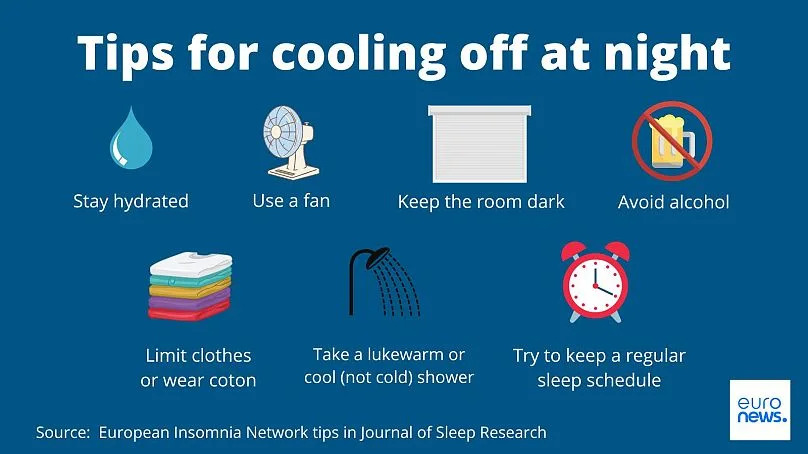
They recommend several methods for cooling down before going to bed including staying hydrated, limiting clothing or wearing cotton, avoiding alcohol, and taking a lukewarm or cool (not cold) shower.

Euronews, Canva
                                                           Here are some tips for cooling off - Euronews, Canva


Fans can help to cool down the room without using as much energy as air conditioning.

While naps can be useful in extreme heat, the researchers said they should be limited to fewer than 20 minutes and not be taken too late in the afternoon.

Pavlova recommends "general sleep hygiene (including) having regularity to the sleep cycle, using the bed for sleep and not for other things and avoiding heat sources close to the bed (such as your computer)".

Policymakers, meanwhile, should encourage equitable access to air conditioning and sustainable energy sources to handle the increased demand, according to Minor, as well as increasing tree coverage and vegetation.

“Unlike air conditioning, these measures can lower local environmental temperatures without discharging waste heat into surrounding areas,” he said.

“This also presents an opportunity for architects, engineers, and designers to contribute positively towards promoting resilient sleep in a warming world”.


How can climate change impact our sleep?

Temperatures are rising rapidly as humans continue to release greenhouse gases into the atmosphere.

July 2023 had the highest global surface air temperature on record for any month becoming the warmest in Earth’s recent history, according to Copernicus, the EU’s earth observation programme.

In Europe, temperatures have increased more than twice the global average over the past three decades.

Minor said that many people aren’t aware that night time temperatures are rising faster than daytime temperatures in most populated regions. This, in turn, will impact people’s sleep.

In his study released in May, they used global climate models to anticipate future sleep loss and found that if countries continue emitting greenhouse gases at the current rate, by 2099 each person could lose an average of 50 to 58 hours of sleep per year.

“This highlights that efforts to curb greenhouse gas concentrations today could help alleviate the uneven impact of night-time warming on human sleep loss globally,” said Minor.

https://uk.news.yahoo.com/heatwaves-harm-erode-sleep-cool-115243287.html 

Wednesday, 2 August 2023

How to sleep in a heat wave, according to experts

From edition.cnn.com

Are you waking up in a puddle of sweat — if you can sleep at all? That’s the grim reality for millions of people around the globe suffering through severe, unbearable heat waves.

Electric fan in-front of an unmade bed with light coming through a window

July is the hottest month on record for the planet and very likely the hottest period in 120,000 years, according to global climate authorities. “These are the hottest temperatures in human history,” Samantha Burgess, deputy director of the European Union’s Copernicus Climate Change Service, told CNN recently.

It’s expected to get worse: A new study found the number of days of “dangerous heat” — defined as 103 degrees Fahrenheit (39.4 degrees Celsius) — will more than double by 2050 in the midlatitude regions, which include Western Europe and countries such as China, Japan and the United States. Tropical areas could face those temperatures for the majority of the year.

No relief at night

It’s not just the unbearable sunshine — temperatures at night aren’t dropping as they should. Nights are warming faster than days on average in most of the US, the 2018 National Climate Assessment found. That’s dangerous for sleep — a vital period when the body and brain do housekeeping chores such as repairing and discarding old cells and generating new ones.

Warm night-time temperatures have robbed people around the world of an average of 44 hours of sleep annually during just the first two decades of the 21st century, according to a 2022 study. And unfortunately, daytime naps and longer sleep on cooler nights did not seem to make up for that lost sleep, researchers found.

To get the best quality sleep, experts have long recommended sleeping in a cool room — between 60 and 67 degrees Fahrenheit (15.6 to 19.4 degrees Celsius) is best. What happens when you can’t achieve that during a heat wave?

Studies have shown higher night-time temperatures increase wakefulness and reduce deep wave and REM (rapid eye movement), both critical to how well the body repairs and refreshes itself at night.

Exposure to heat waves during pregnancy may be associated with adverse outcomes such as preterm birth, according to a 2019 study. Older adults may have higher heart rates and more physiological stress when sleeping in warmer temperatures. A 2008 Australian study even found deaths due to mental and behavioural disorders rose during heat waves, especially for older adults.

10 tips for sleeping in the heat

Learning how to better cope with sleep problems during heat waves might limit the negative impact on our health, according to a team of experts from the European Insomnia Network. Here are their top tips, along with some guidance from experts in the US.

Stay hydrated. Drinking plenty of water during the day can help your body better regulate your temperature at night.

But don’t drink for the hour or two before bed, or you’ll end up waking yourself in the night to go to the bathroom, said sleep specialist Dr. Raj Dasgupta, an associate professor of clinical medicine at the Keck School of Medicine at the University of Southern California. Instead, “try sucking on ice cubes before bed.”

Eat light. Eating lighter, especially for the last meal of the day, can help set you up for better sleep, experts say. Avoid sugar and carb-laden foods, saturated fats and too much fibre as the day goes on, as that can disrupt sleep as well, according to a 2016 study.

Dress lightly. Sleep in the buff or choose loose, cotton clothing — avoid synthetics, which can trap heat next to the skin.

Look for chances to cool the bedroom. If you’re lucky enough to have a cooler period during the day, open windows and doors and start up fans to ventilate the bedroom, then close it off when the temperature rises.

If there are no breaks from the heat, close blinds, pull window shades, and do what you can “to keep the house and bedroom as cool and dark as possible both during day and night,” the network experts suggested.

Avoid alcohol. Drinking booze in the evening dehydrates the body and sets you up for night-time sweats, said Dr. Phyllis Zee, chief of sleep medicine and professor of neurology at Northwestern University Feinberg School of Medicine in Chicago.

Set aside time to relax. For you and your child, set aside an hour or more before bedtime for calming activities, such as “reading a book, listening to a story or to music. This could help in cooling down and relaxing,” according to the network.

Shower in tepid water. Before you hit that hot sack, take a lukewarm or cool (but not cold) shower or foot bath, which may help to reduce your heat stress and set you up for sleep. How does that happen?

“Your body temperature lowers after you leave the shower or bath as your body adapts to the cooler environment,” Dasgupta said. “This drop in temperature prepares your body for sleep because our body temperature has a natural circadian rhythm — the body is primed to cool down when you lay down and warm up when you get up.”

Find the coolest place to sleep. Try your best to keep your bedroom cooler than 77 degrees Fahrenheit (25 degrees Celsius) if you can. To do so, try using ceiling fans or floor or bedside electric fans, which use “up to 50-times less electricity” than air conditioning,” the review noted.

“There are also fairly inexpensive ice cooling fans that can be placed near the bed,” Zee told CNN. “If you’re unable to keep the bedroom cool, sleeping temporarily on lower floors like the basement (if there is one) will be cooler.”

Keep a regular sleep schedule. If you sleep badly one night, don’t go to bed early the next, experts said. It’s important to stick to a regular bedtime to train the brain that it’s time to sleep, regardless of the temperature.

If you do wake up early and can’t go back to sleep without 15 to 20 minutes, get up and do something soothing and mindless, such as folding laundry, until you’re sleepy. If that doesn’t work, start your day, the network experts suggest.

Exercise safely. Don’t put aside exercise, even in the heat. Try to do some physical activity in the early morning, when it is still relatively cool outdoors, experts suggest, as a key way to keep a regular sleep and wake schedule.

https://edition.cnn.com/2023/07/31/health/sleep-cooler-heat-wave-wellness/index.html