Showing posts with label music. Show all posts

Monday, 4 November 2024

Music vs Insomnia: How does music aid my sleep?

From bona.co.za

Ever found yourself struggling with insomnia, and no matter how much you toss and turn, just cannot seem to find the perfect position to fall asleep – until you make the decision to listen to calming music and you are instantly taken away by your dreams?

For many, the moment brings so much relief as it ensures that you ultimately get in proper sleep so you can be fresh for whatever the next day requires.

When it comes to music, there is a strong link between the sweet melodies and their ability to help one fall into a proper sleep.

“Music can aid sleep by helping you feel relaxed and at ease. With streaming apps and portable speakers, it’s easier than ever to take advantage of the power of music wherever you go,” explains the Sleep Foundation.

                                                                         Illustration. Picture: Pexels

According to the above-mentioned publication, music has long been a powerful source when it comes into contact with the human body. For years it has not only allowed humans to express their joy through dance, or sadness through crying but has also been a way to calm our minds.

Since birth, this has been the go-to solution when parents experiment with the singing of lullabies and gentle rhythms so babies can fall asleep.

In an article published by UC Davis Health Jesse Koskey, a psychiatrist in the UC Davis Department of Psychiatry and Behavioural Science found that music is a low-cost and accessible treatment which is effective for overcoming insomnia in comparison to a sleeping pill.

He explains that listening to slow-tempo songs produces an effect known as entrainment. This is when your body synchronises with your environment.

“Music around 60 beats per minute, which is the same as a relaxed heart, can entrain the rest-and-digest part of your nervous system, leading to a slower, more relaxed heart rate,” he explains.

According to the British publication Belledorm, these are the kinds of music to listen to before bed:

  • Acoustic
  • Classical
  • Chillout
  • Lullabies
  • White noise
  • Ambient sounds

Friday, 4 November 2022

Daytime music could help you sleep at night

From irishnews.com

LYING down twice a day and listening to music can be a successful way to treat insomnia.

In a new trial at Woosong University in South Korea, around 100 people with insomnia were given music therapy or no treatment, and had their symptoms measured before and after the study.

Treatment involved lying down two to three times a day, for around 30 minutes per session. Results showed the music group went to sleep in half the time it took the others to nod off, and one in four was 'cured' of their insomnia.

Music is thought to help sleep by lowering the heart rate and relaxing the body. The overall success rate was 96 per cent, according to the Journal of Healthcare Engineering.

https://www.irishnews.com/lifestyle/health/2022/11/03/news/daytime_music_could_help_you_sleep_at_night-2873320/ 

Friday, 27 August 2021

Nocturnes and Max Richter: The best music for falling asleep

From bbc.com/culture

From Chopin and Debussy to modern-day composers of Nocturnes, people have always felt a need to create night music. Arwa Haider explores how that can help us now, as we navigate pandemic-induced insomnia

Sleeplessness was a symptom of the pandemic lockdowns for countless people. For award-winning orchestral, electronic and film composer/musician Craig Armstrong, the long restless nights would lead him on late walks in his Glasgow neighbourhood, where he'd find the eerie solitude ruptured by the blare of ambulances rushing to the city hospital. These nights would also draw him to his home studio, where he'd stay up composing pieces that would eventually form his latest album, Nocturnes: Music for Two Pianos.

"I found myself regularly in my little studio at home at two, three, four o'clock in the morning; I just started writing away on my piano," Armstrong tells BBC Culture. "I think the motivation was to take my mind off the nightmare that was going on. It was a very dark period for a lot of people; I know a lot of people who've had such a hellish time, and I wanted there to be some light at the end of the tunnel."

The 14 intimate tracks that comprise Armstrong's Nocturnes might seem relatively simple in contrast with much of his expansive catalogue (which has spanned movie scores including Baz Luhrmann's Romeo + Juliet and the music legend biopic Ray, as well as collaborations from Massive Attack to the Royal Shakespeare Company); still, they prove richly emotive and absorbing. They also extend the deep-rooted and creatively fluid tradition of nocturnes, or night music. Influential Irish composer/pianist/teacher John Field published the first specifically-named nocturnes in 1814. The form (music created to be played after 11pm) took further flight through the works of artists such as Frédéric Chopin (who published 18 nocturnes between 1832 and 1846, with an additional three published after his death in 1849), Claude Debussy (whose Trois Nocturnes, published in 1900, were inspired by Henri de Régnier's French symbolist poetry), 20th-Century composers from Erik Satie to Benjamin Britten, and many more.
With his latest album, Armstrong has shifted to a different kind of soundtrack (Credit: Simon Murphy)

With his latest album, Armstrong has shifted to a different kind of soundtrack (Credit: Simon Murphy)

"The idea of calling this album Nocturnes was a practical thing; they're all written in the middle of the night," smiles Armstrong. "The form of a nocturne is not set. I think for a lot of musicians, it was a form that gave a lot of freedom; it doesn't have the straitjacket of making a massive statement. They're little vignettes that capture a moment. It's a concise emotional musical space."

At night-time, sounds also have a very different quality to the day; these senses probably do seem heightened – Armstrong

Armstrong's Nocturnes are fairly brief, ranging from between one and five minutes, but they're heartfelt and consciously hopeful expressions. He plays both piano parts himself, as lockdown precluded meeting other musicians ("With two pianos, you could get into very textural sounds; your ear doesn't quite know who's playing what, it's almost ambient"). The night moods are headily reflective rather than linear; Nocturne 11 is a tribute to much-loved Japanese artist Ryuichi Sakamoto's seemingly simple (yet intricately multi-layered) compositional style, while the elegant Nocturne 12 takes inspiration from a music box that once belonged to Armstrong's paternal grandmother.

"I guess there's the question of how you perceive time, at different points of the day," says Armstrong. "At night-time, sounds also have a very different quality to the day; these senses probably do seem heightened."

Blurred lines

Creative boundaries are arguably most blurred after dark. Night music obviously isn't restricted to Western classical realms; jazz standards are steeped in sleepless atmospheres (take Thelonious Monk's 1944 bebop classic 'Round Midnight). Awake late at night, we might feel drawn to revelry, or devotion (or both); Indian classical music has spiritual ragas associated with different times of the day (as well as various seasons). In The Times of India (September 2016), classical vocalist Pandit Jasraj described mesmerising Hindustani Malkauns as a form "sung during small hours of the morning, just after midnight. The effect of the raga is soothing and intoxicating."

The academic essay collection Nocturnes: Popular Music and the Night explores multi-genre night music scenes around the world, from London to Berlin, Tokyo and Yogyakarta, and posits that music is "redeemed" late at night, when it transforms from "background noise" to a pivotal force. Editors Giacomo Bottà and Geoff Stahl write: "Music animates the night by both mirroring and contributing to its tempo, stimulating movement within and between nightclubs, bars and music venues to give the city its nocturnal tenor and social power. Each feeds and amplifies the other's intensity, a cordoning off of social energies that affirms again night's difference to the more sedentary trappings of the day."

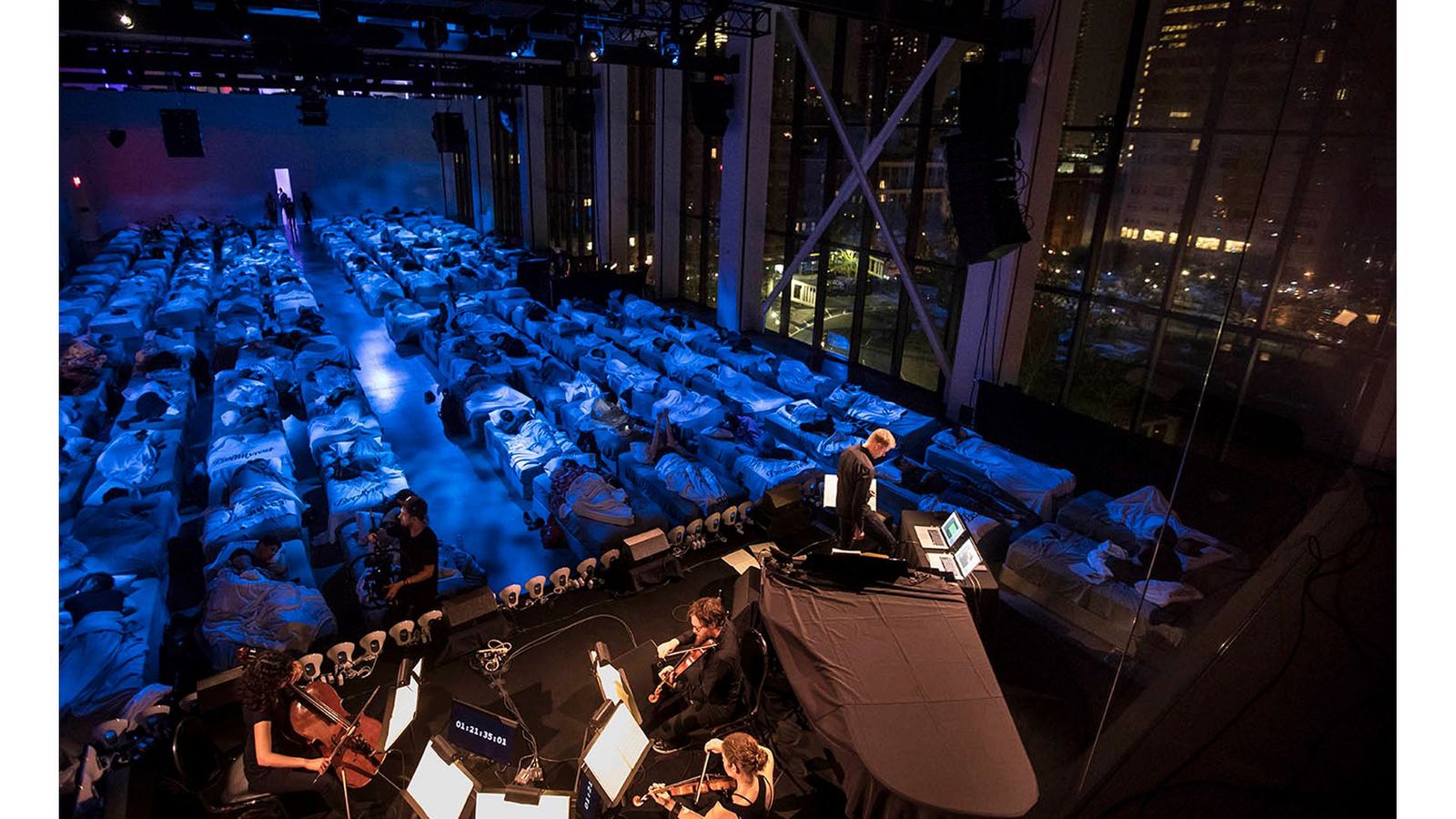
Max Richter has performed his eight-hour Sleep composition around the world, including in Sydney, Paris, London and LA (Credit: BBC/JA Films and Globe Productions/Mike Terry)

Max Richter has performed his eight-hour Sleep composition around the world, including in Sydney, Paris, London and LA (Credit: BBC/JA Films and Globe Productions/Mike Terry)

As a child, I sensed that the night-time could be an otherworldly playground (although I was also scared of the dark). By my late teens, staying up all night was a rite of passage, whether I was clubbing or completing essay deadlines. Night music always seemed to sharpen the senses – not just on the dancefloor, but beyond it: sound-tracking these nebulous hours, where one date bleeds into the next. Many contemporary songs capture that sleepless atmosphere, whether it's Faithless's 1995 club stormer Insomnia (with its "I can't get no sleep" refrain), The KLF's majestic rave-pop hit 3am Eternal (1991) or Tyree Cooper's seminal Chicago house track I Fear The Night (1986); enigmatic producer Burial also summoned heavy nocturnal moods on his self-titled 2006 album (including the elegiac track Night Bus). This year, British singer-songwriter Puma Blue (aka Jacob Allen) explored his personal long-term struggles with insomnia, on his excellent debut album, In Praise of Shadows. Puma Blue's expressions sound both exquisite and intensely raw, on woozy electro-soul melodies such as Opiate ("Sleep much longer than I did before… Bless these angels hanging over my head/ Still as a tomb, though, I'm scared instead because/ I must be losing my mind").

One of the most incredible live concerts I've ever experienced was an 11pm-7am continuous performance of Max Richter's "eight-hour lullaby" Sleep (2015), played to an audience in sleeping bags. I recall drifting in and out of slumber throughout the eight-hour set, and each time I resurfaced, I felt reassured by the musicians' presence, and cradled by the sounds – from womb-like sub-bass rhythms to an eventual "musical sunrise", gently elevating in volume and pitch.

We're on the screen all the time, which means we have to be 'on' all the time. I wanted to make a piece that could function as an antidote to that – Max Richter

Richter developed Sleep in collaboration with neuroscientist David Eagleman, with nods to classical inspirations such as Johann Sebastian Bach's Goldberg Variations (1741), which were commissioned by an insomniac diplomat; rising star pianist Pavel Kolesnikov will also perform the Goldberg Variations as a highlight of this year's BBC Proms, on 10 September. 

When I interviewed Richter, he explained: "Sleep comes out of a really personal feeling. I was getting really exhausted by the increasing virtualisation of our lives; we're on the screen all the time, which means we have to be 'on' all the time. I wanted to make a piece that could function as an antidote to that and reclaim some basic human things from the technological mode of existence. I've always felt like sleep is the great reservoir, where we can connect to something that's bigger than us – so I wanted to encourage that, and also make a political piece that's about stepping off the treadmill.

Richter calls Sleep a "personal lullaby for a frenetic world… a manifesto for a slower pace of existence" (Credit: Getty Images)

Richter calls Sleep a "personal lullaby for a frenetic world… a manifesto for a slower pace of existence" (Credit: Getty Images)

"One of the other starting points with Sleep was very direct; when our kids were little, I would go off and play a show which would be streamed or on the radio, and Yulia [Mahr, Richter's wife] would often hear the show in some weird time zone, in the middle of the night. This boundary layer when you're half-asleep, we started thinking about that as a space for music to happen. Performing Sleep live is kind of like extreme sports," he added. "I have hundreds of pages of piano music, and it's a physical challenge. I have to get 'jetlagged' so that it's 'morning' when I go on."

Another contemporary talent who has taken inspiration from sleepless hours is composer/musician Anna Meredith, in her beautifully haunting 2011 work Four Tributes To 4am, based on nocturnal recordings around the city of Derby. "I think I'd read this depressing statistic that more people die at 4am than at any other time," muses Meredith. "I've always found 4am a bit of a 'no-man's time'; 3am is like good times from the night before, and 5am might be an early start, but you might not know where 4am fits in terms of yesterday and the next day.

"I had an idea of doing these mini-portraits of what different parts of the town feel like at 4am. My sister [film-maker Eleanor Meredith] and I did an all-nighter, trawling around the dual carriageway with our recorders – the houses, the clubs at the end of the night, the park, the dual carriageway with cars passing by, an out-of-town shopping mall that was totally deserted apart from a few security guards. I remember deliberately slowing the tempo down to create this weighty, unwieldy atmosphere, before gradual awakening in the final movement. You're awake at this 'magic hour' when everyone else is asleep and at their most vulnerable. It feels like you've tapped into a secret."

That sense of discovering secrets and subverting codes is also what makes night music so powerful; we are sleepless but hyper-sensitive – and as Armstrong also notes with his Nocturnes, there is the promise of emerging through the darkness, into a new light.

https://www.bbc.com/culture/article/20210825-nocturnes-and-max-richter-the-best-music-for-falling-asleep

Friday, 15 January 2021

Study reveals the relaxing music to help you sleep

From newsroom.unsw.edu.au

If you have trouble turning off at night, could switching on a little bit of music help you get some quality shut-eye? 

Perhaps there’s nothing quite as frustrating as trying and failing to fall asleep. But if you’re one of the many people who struggle to switch off come bedtime, the findings of a new study might give you some hope – and the songs – you need to help you get your dream on.

UNSW PhD student in the science of music for sleep, Thomas Dickson says that listening to music could hold the answer to a better night’s sleep. The music psychology researcher says listening to music at bedtime can not only help people fall asleep quicker but also improve sleep quality.

“Music has a solid evidence base as one of the better researched non-pharmacological sleep aids that can improve individual’s sleep, both in terms of insomnia and the quality of sleep,” he says.

According to Mr Dickson’s research, listening to music changes what can be a stressful experience of trying to sleep into a more pleasant one. As well as inducing relaxation and a sleepier state, music offers a distraction from stressful thoughts and can also mask out distracting noises in the environment.

His latest study with Professor Emery Schubert, Musical Features that Aid Sleep, published in Musicae Scientia, goes one step further, identifying the specific characteristics of music that is successful in aiding sleep.

“While previous studies of music as a sleep aid have shown music to be beneficial in helping sleep, little research has investigated the specific features of music that have improved sleep,” Mr Dickson says.

“In this study, we asked individuals about what music they’ve used in the past, and did it successfully help them sleep. We identified that music successfully used for sleep had certain musical properties, compared to music that was unsuccessful.”

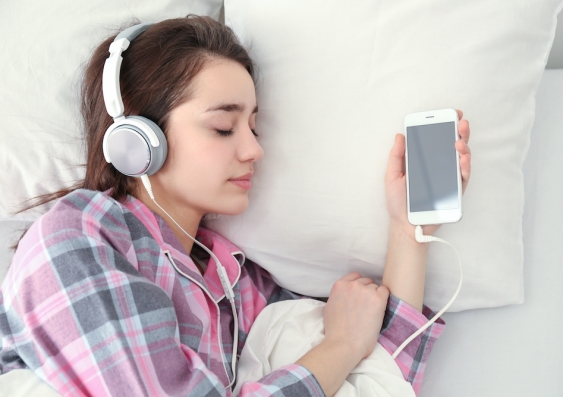
woman sleeping in bed while listening to music through headphones

A new study reveals the specific features of music that can help improve sleep quality.

Photo: Shutterstock.

Musical features to aid sleep

The study revealed music that aided sleep had more emphasis in lower frequencies such as a stronger bass, had a slow and sustained duration of musical notes, and had non-danceable rhythms. 

“In music terms, the music had quite a dark mix, it was legato, and was not complex or strong in rhythmic activity,” Mr Dickson says.

The research also suggests it’s not just classical music or lullabies that can help people sleep. In fact, individuals can fall asleep to a wide variety of music genres.

“Based on the findings of the study, we have evidence that the musical features we uncovered appeared to be more important than the genre in aiding sleep,” he says. 

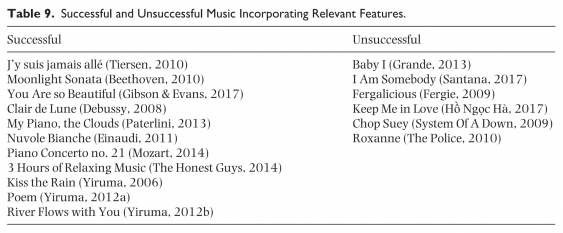
table of songs successful in aiding sleep

The list of songs successful in aiding sleep share similar musical features. Image: Supplied.

For those considering turning on the speaker to help switch off, consistency is key. 

Mr Dickson recommends making music a part of your bedtime routine. He says developing the habit of listening to music for 45 minutes at bedtime for about a month has been shown to positively impact sleep patterns. 

However, if you’re a healthy sleeper, music isn’t likely to improve the quality of your sleep further. And while there are no known side effects for using music as a sleep aid, it’s always best to consult with your GP first, Mr Dickson says.

“Music is most useful for people who struggle to sleep because of insomnia related to anxiety or stress, rather than medical issues like sleep apnoea,” he says. 

“If you listen to music every night, at the same time for at least three weeks, at that point, we start statistically seeing improved sleep quality, and individuals with insomnia becoming healthy sleepers.” 

For your best chance for a good night’s sleep with music, Mr Dickson suggests compiling a dedicated sleep playlist with songs that have the characteristics conducive to aiding sleep. He also recommends the volume is kept under 40 decibels, which is about as quiet as comfortably possible.

“If people listen to music they enjoy, they can enjoy going to sleep more,” he says.

Mr Dickson is writing a book on the science of music for sleep to be released in 2021. His mobile app ‘Can’t Sleep’ incorporates the musical features of his research to help sleep and is available on iPhone and Android.

https://newsroom.unsw.edu.au/news/social-affairs/study-reveals-relaxing-music-help-you-sleep

Monday, 26 October 2020

Music and Sleep

From sleepfoundation.org

Music is a powerful art form. While it may get more credit for inspiring people to dance, it also offers a simple way to improve sleep hygiene, improving your ability to fall asleep quickly and feel more rested.

Music can aid sleep by helping you feel relaxed and at ease. With streaming apps and portable speakers, it’s easier than ever to take advantage of the power of music wherever you go. Given music’s accessibility and potential sleep benefits, it might be a good time to try adding it to your nightly routine.

Music is a powerful art form. While it may get more credit for inspiring people to dance, it also offers a simple way to improve sleep hygiene, improving your ability to fall asleep quickly and feel more rested.

Music can aid sleep by helping you feel relaxed and at ease. With streaming apps and portable speakers, it’s easier than ever to take advantage of the power of music wherever you go. Given music’s accessibility and potential sleep benefits, it might be a good time to try adding it to your nightly routine.

Can Music Help You Fall Asleep?

Parents know from experience that lullabies and gentle rhythms can help babies to fall asleep. Science supports this common observation, showing that children of all ages, from premature infants to elementary school children, sleep better after listening to soothing melodies.

Fortunately, children aren’t the only ones who can benefit from lullabies before bedtime. People across age groups report better sleep quality after listening to calming music.

In one study, adults who listened to 45 minutes of music before going to sleep reported having better sleep quality beginning on the very first night. Even more encouraging is that this benefit appears to have a cumulative effect with study participants reporting better sleep the more often they incorporated music into their nightly routine.

Using music can also decrease the time it takes to fall asleep. In a study of women with symptoms of insomnia, participants played a self-selected album when getting into bed for 10 consecutive nights.  Before adding music to their evening routine it took participants from 27 to 69 minutes to fall asleep, after adding music it only took 6 to 13 minutes.

In addition to facilitating quickly falling asleep and improving sleep quality, playing music before bed can improve sleep efficiency, which means more time that you are in bed is actually spent sleeping. Improved sleep efficiency equals more consistent rest and less waking up during the night.

Why Does Music Affect Sleep?

The ability to hear music depends on a series of steps that convert sound waves coming into the ear into electrical signals in the brain. As the brain interprets these sounds, a cascade of physical effects are triggered within the body. Many of these effects either directly promote sleep or reduce issues that interfere with sleep.

Several studies suggest that music enhances sleep because of its effects on the regulation of hormones, including the stress hormone cortisol. Being stressed and having elevated levels of cortisol can increase alertness and lead to poor sleep. Listening to music decreases levels of cortisol, which may explain why it helps put people at ease and release stress.

Music triggers the release of dopamine, a hormone released during pleasurable activities, like eating, exercise, and sex. This release can boost good feelings at bedtime and address pain, another common cause of sleep issues. Physical and psychological responses to music are effective in reducing both acute and chronic physical pain. 

Listening to music can also contribute to relaxation by soothing the autonomic nervous system. The autonomic nervous system is part of your body’s natural system for controlling automatic or unconscious processes, including those within the heart, lungs, and digestive system. Music improves sleep through calming parts of the autonomic nervous system, leading to slower breathing, lower heart rate, and reduced blood pressure.

Many people with poor sleep associate their bedrooms with frustration and sleepless nights. Music can counteract this, distracting from troubling or anxious thoughts and encouraging the physical and mental relaxation needed to fall asleep.

Night-time noise, whether it’s from roads, airplanes, or noisy neighbours, can decrease sleep efficiency and is linked to several adverse health consequences including cardiovascular disease. Music can help to drown out these environmental noises and increase sleep efficiency.

What Kind of Music is Best for Sleep?

It’s natural to wonder about the best type of music for sleep. Research studies have looked at diverse genres and playlists and there isn’t a clear consensus about the optimal music for sleep. What we do know is that studies have typically used either a self-curated playlist or a one that has been designed specifically with sleep in mind.

One of the most significant factors in how music affects a person’s body is their own musical preferences. Effective custom playlists may include songs that have been relaxing or that have helped with sleep in the past.

When designing a playlist, one factor to consider is the tempo. The tempo, or speed, at which music is played is often measured in the amount of beats per minute (BPM). Most studies have selected music that is around 60-80 BPM. Because normal resting heart rates range from 60 to 100 BPM, it’s often hypothesized that the body may sync up with slower music.

For those that don’t want to design their own playlist, online music services have stepped in and usually offer pre-packaged playlists for specific activities. Helpful playlists may be curated for sleep or relaxation. It may be easiest to find playlists that focus on calming genres, like classical or piano pieces.

Feel free to experiment with different songs and playlists until you find one that’s right for you. It may also be helpful to try out a few playlists during the daytime to see if they help you relax.

Music Therapy

While many people can benefit from making their own playlists or finding something pre-mixed, others may benefit from a more formal approach. Certified music therapists are professionals trained in using music to improve mental and physical health. A music therapist can assess a person’s individual needs and create a treatment plan that can involve both listening to and creating music. For more information on music therapy, talk with your doctor or visit the American Music Therapy Association.

Evolving Science About Music and Health

Interest in music’s effects on the body continues to grow, and major research programs are dedicated to uncovering new ways that music can benefit health. For example, in 2017 the National Institutes of Health partnered with the John F. Kennedy Centre for the Performing Arts to announce the Sound Health Initiative. This program initiative supports research that focuses on the use of music in health care settings and has already funded several projects.

How to Make Music Part of Your Sleep Hygiene

Music can be a great part of healthy sleep hygiene. Here are a few tips to keep in mind while incorporating music into a sleep-promoting evening routine.

  • Make it a habit: Routine is great for sleep. Create evening rituals that give the body sufficient time to wind down, incorporating music in a way that’s calming and consistent.
  • Find enjoyable songs: If a pre-made playlist isn’t working, try making a mix of songs that you find enjoyable. While many people benefit from songs with a slower tempo, others may find relaxation with more upbeat music. Feel free to experiment and see what works best.
  • Avoid songs that cause strong emotional reactions: We all have songs that bring up strong emotions. Listening to those while trying to sleep may not be a great idea, so try music that’s neutral or positive.
  • Be careful with headphones: Headphones and earbuds may cause damage to the ear canal while sleeping if the volume is too high. Sleeping with earbuds can also lead to a build-up of earwax and may increase the risk of ear infections. Instead, try setting up a small stereo or speaker somewhere close to the bed. Choosing speakers without bright light, which can interfere with sleep, and find a volume that is soothing and not disruptive.