Wednesday, 13 August 2025

Study: Self-guided, online treatment helps older adults combat insomnia

From wtop.com

An online insomnia treatment developed at the University of Virginia is stepping in to help older people who struggle to fall asleep and stay asleep, according to the treatment creator.

“Older adults do have a more difficult time with insomnia,” said Lee Ritterband, PhD., the director of UVA Health’s Center for Behavioral Health and Technology. “They tend to have a difficult time with falling asleep and waking in the middle of the night, having trouble falling back asleep, and also waking up early in the morning, before they’re wanting to get up.”

Ritterband is the creator of the SHUTi OASIS intervention, which stands for “Sleep Healthy Using the Internet for Older Adults Suffering with Insomnia and Sleeplessness.” He said it’s the first digital health program for insomnia, specifically for adults over the age of 55. One of the 311 participants in the trial was 95 years old.

One of the most important aspects, according to Ritterband, is that older adults were generally able to do the internet-based program without technical support from others. Ritterband said the treatment would benefit many older people who might not have access to in-person treatment because of location or cost.

What is the user experience?

“It’s a web page, they can do it on their phone, they can do it on their computer,” said Ritterband. “It’s text, it’s pictures, it’s videos, it’s interactions they can interact with by clicking and dragging and dropping and moving things around.”

Ritterband said researchers expected older users to have more difficulty navigating the treatment: “Almost nobody needed support, we were blown away with how well people were able to do it on their own.”

How does SHUTi work, help?

Ritterband said the SHUTi (pronounced “shut eye”) treatment is based on cognitive behavioral therapy.

When a person is struggling to fall asleep, “They’re having some thoughts that might be interfering — maybe they’re feeling anxious, maybe their mind is racing — those are the cognitive components,” said Ritterband.

The program teaches users to manage those intrusive thoughts, “and how to think about things, maybe a little bit differently,” he said.

On the behavioural side, Ritterband said the program integrates information the users supply in sleep diaries, “and that’s taking that data and creating a very tailored program for that particular person.”

Ritterband said the algorithm helps a user determine what time they should go to sleep and what time they should wake up.
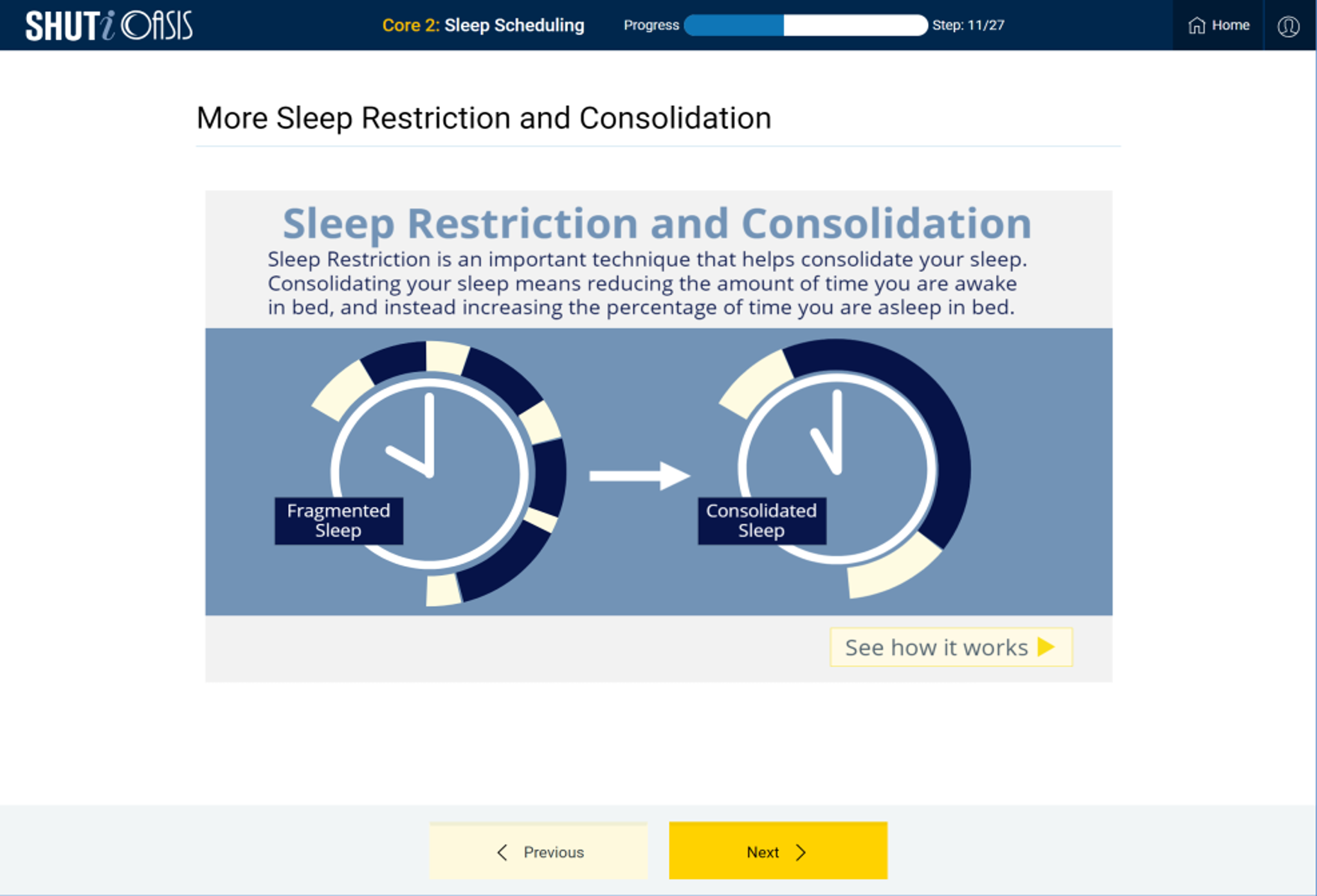
Sleep Restriction and Consolidation chart
(Courtesy University of Virginia)

In addition, it provides stimulus control guidelines — a set of rules that patients are encouraged to follow.

“Things like don’t go to bed if you’re not sleepy, don’t stay in bed for more than twenty minutes awake,” said Ritterband. “And, if you are, get out of bed, do some quiet activity, and only go back into bed when you’re feeling sleepy.”

According to the study published in the scientific journal npj Digital Medicine, participants either used the SHUTi OASIS program by themselves, with technical assistance, or received standard online information about insomnia.

According to the study, the online program significantly outperformed the standard materials at the end of the trial, six months later, and again a year after the trial ended, based upon participants’ descriptions of their ability to sleep and by clinical indicators of insomnia and remission.

https://wtop.com/health-fitness/2025/08/study-self-guided-online-treatment-helps-older-adults-combat-insomnia/

Tuesday, 12 August 2025

Conch blowing could help to alleviate sleep apnoea, study suggests

From theguardian.com 

Blowing into a conch shell could help tackle the symptoms of a sleep disorder that affects millions of people across the UK, according to a study.

Conch blowing, also known as shankh blowing, is an ancient ritual that involves breathing in deeply and exhaling into the spiral-shaped shell.

The practice could improve sleep for patients with obstructive sleep apnoea (OSA), which usually needs to be treated with uncomfortable machinery, according to the research.

OSA occurs when breathing starts and stops during sleep. Symptoms include loud snoring and making gasping or choking noises.

Thirty people living with the disorder and aged between 19 and 65 were involved in the trial, led by researchers at the Eternal Heart Care Centre and Research Institute in Jaipur, India.

About half of the group were taught how to use the shell, while the others carried out deep breathing exercises. Both groups were encouraged to practise their techniques for at least 15 minutes, five days a week.

Six months later, the trial found that those who had practiced shankh blowing were 34% less sleepy during the day. They also had higher blood oxygen levels during the night, and four to five fewer OSA episodes an hour on average.

“Shankh blowing is a simple low-cost breathing technique that could help improve sleep and reduce symptoms without the need for machines or medication,” said Dr Krishna K Sharma, who led the research.

“The way the shankh is blown is quite distinctive. This action creates strong vibrations and airflow resistance, which likely strengthens the muscles of the upper airway, including the throat and soft palate, areas that often collapse during sleep in people with OSA.”

Conch blowing is an ancient ritual that involves breathing in deeply and exhaling into the spiral-shaped shell.Photograph: Eduardo Verdugo/AP

The most common form of treatment for sleep apnoea is a continuous positive airway pressure (Cpap) machine, which involves patients wearing a mask that blows pressurised air into the nose and throat while asleep. Previous research has also found that playing a woodwind instrument could help with the condition.

Although the machines are effective, they can be uncomfortable, leading the researchers to suggest that shankh blowing could be a promising alternative.

A larger trial involving several hospitals is being planned.

“The findings of this trial are encouraging, but the small scale of the trial means it’s too soon to say for certain that conch blowing can help people manage their obstructive sleep apnoea,” said Dr Erika Kennington, the head of research and innovation at Asthma + Lung UK.

“It’s also not clear from this research why blowing through a conch shell regularly might improve someone’s symptoms. It would be good to see the conch blowing approach tested on a larger scale and compared with other proven strategies, such as limiting alcohol, staying active and maintaining good bedtime habits.

“OSA is a long-term condition, but with the right treatments and lifestyle changes, people can make a real difference to their symptoms.”

https://www.aol.co.uk/news/conch-blowing-could-help-alleviate-040041990.html

Sunday, 10 August 2025

Home help: I suffer from insomnia. How can I make my bedroom more conducive to sleep?

From independent.ie 

Darren Kennedy gets tips from an expert on how to set up your bedroom for a proper night’s rest

You’re not alone. According to new research from furniture company DFS, many of us are getting just three good nights’ sleep a week, with one in six people saying they never get a proper night’s rest. And while high-tech gadgets and supplements are becoming increasingly popular, sleep expert Anne Marie Boyhan says it all starts with your bedroom environment.

                                                                                                          Anne Marie Boyhan

First things first: clutter. It might sound simple, but keeping your bedroom clean and tidy can have a huge impact. That pile of laundry in the corner or cluttered bedside table can elevate stress levels. Studies show that sleeping in a messy room can actually increase sleep disturbances.

Then there’s your bed itself. According to the research, nearly a third of people blame an uncomfortable bed for poor sleep. Boyhan says: “Rotate your mattress every six months and replace it after 10 years.” A good mattress and supportive pillows are not a luxury but a necessity if you want to sleep better and feel energised the next day.

Summer adds another layer of difficulty. The optimal room temperature for sleep is around 18.3C, but many Irish bedrooms creep into the 20s during warmer months, which disrupts melatonin production and makes it harder to fall and stay asleep. “Your core body temperature needs to drop in order for you to fall asleep,” says Boyhan. “That means your bedroom set-up is crucial.”

Her advice? Keep your bedroom cool and dark. During the day, close windows and curtains to keep heat out. In the evening, use a fan to circulate air and take a lukewarm shower before bed to help lower your core temperature gradually. Swap out heavy duvets for low-tog alternatives or use a light throw, and opt for breathable, natural fabrics for bedding and sleepwear – synthetics can trap heat and make you sweat.

Blackout blinds are ideal, but if they’re not an option, a good eye mask will help block out summer light. And this is smart: fill a hot water bottle with cold water and place it by your feet in bed. It cools you down slowly, helping your body relax into sleep.

If insomnia continues to be a challenge, it might be worth investing in a mattress with temperature-regulating properties — some are designed specifically to increase airflow and help you to stay cool through the night.

Friday, 8 August 2025

Dangerous dreams: Inside internet's 'sleepmaxxing' craze

From france24.com

Washington (AFP) – From mouth taping to rope-assisted neck swinging, a viral social media trend is promoting extreme bedtime routines that claim to deliver perfect sleep -- despite scant medical evidence and potential safety risks 

Influencers on platforms including TikTok and X are fuelling a growing wellness obsession popularly known as "sleepmaxxing," a catch-all term for activities and products aimed at optimizing sleep quality.

The explosive rise of the trend -- generating tens of millions of posts -- underscores social media's power to legitimize unproven health practices, particularly as tech platforms scale back content moderation.

One so-called insomnia cure involves people hanging by their necks with ropes or belts and swinging their bodies in the air.

"Those who try it claim their sleep problems have significantly improved," said one clip on X that racked up more than 11 million views.

Experts have raised alarm about the trick, following a Chinese state broadcaster's report that attributed at least one fatality in China last year to a similar "neck hanging" routine.

Such sleepmaxxing techniques are "ridiculous, potentially harmful, and evidence-free," Timothy Caulfield, a misinformation expert from the University of Alberta in Canada, told AFP.

"It is a good example of how social media can normalize the absurd."

Another popular practice is taping of the mouth for sleep, promoted as a way to encourage nasal breathing. Influencers claim it offers broad benefits, from better sleep and improved oral health to reduced snoring.

But a report from George Washington University found that most of these claims were not supported by medical research.

Experts have also warned the practice could be dangerous, particularly for those suffering from sleep apnoea, a condition that disrupts breathing during sleep.

Other unfounded tricks touted by sleepmaxxing influencers include wearing blue- or red-tinted glasses, using weighted blankets, and eating two kiwis just before bed.

The trend of 'sleepmaxxing,' featuring mouth taping, eye masks and other bedroom practices with unproven health effects, is being promoted on social media by online influencers © Drew ANGERER / AFP

'Damaging'

"My concern with the 'sleepmaxxing' trend -- particularly as it's presented on platforms like TikTok -- is that much of the advice being shared can be actively unhelpful, even damaging, for people struggling with real sleep issues," Kathryn Pinkham, a Britain-based insomnia specialist, told AFP.

"While some of these tips might be harmless for people who generally sleep well, they can increase pressure and anxiety for those dealing with chronic insomnia or other persistent sleep problems."

While sound and sufficient sleep is considered a cornerstone of good health, experts warn that the trend may be contributing to orthosomnia, an obsessive preoccupation with achieving perfect sleep.

"The pressure to get perfect sleep is embedded in the sleepmaxxing culture," said Eric Zhou of Harvard Medical School.

"While prioritizing restful sleep is commendable, setting perfection as your goal is problematic. Even good sleepers vary from night to night."

Pinkham added that poor sleep was often fuelled by the "anxiety to fix it," a fact largely unacknowledged by sleepmaxxing influencers.

"The more we try to control sleep with hacks or rigid routines, the more vigilant and stressed we become -- paradoxically making sleep harder," Pinkham said.

Beauty over health

Many sleepmaxxing posts focus on enhancing physical appearance rather than improving health, reflecting an overlap with "looksmaxxing" –- another online trend that encourages unproven and sometimes dangerous techniques to boost sexual appeal.

Some sleepmaxxing influencers have sought to profit from the trend's growing popularity, promoting products such as mouth tapes, sleep-enhancing drink powders, and "sleepmax gummies" containing melatonin.

That may be in violation of legal norms in some countries like Britain, where melatonin is available only as a prescription drug.

The American Academy of Sleep Medicine has recommended against using melatonin to treat insomnia in adults, citing inconsistent medical evidence regarding its effectiveness.

Some medical experts also caution about the impact of the placebo effect on insomnia patients using sleep medication -- when people report real improvement after taking a fake or non-existent treatment because of their beliefs.

"Many of these tips come from non-experts and aren't grounded in clinical evidence," said Pinkham.

"For people with genuine sleep issues, this kind of advice often adds pressure rather than relief."

https://www.france24.com/en/live-news/20250807-dangerous-dreams-inside-internet-s-sleepmaxxing-craze

Wednesday, 6 August 2025

Is your job costing you sleep?

From consumeraffairs.com

New research reveals how desk time and odd hours may quietly disrupt your rest

  • Findings from a recent study found that sedentary jobs—where you sit most of the day—were tied to a 37% rise in insomnia-like symptoms over 10 years.

  • Non-traditional work schedules (like evening or weekend shifts) led to a 66% higher risk of needing “catch-up sleep” such as naps or sleeping in.

  • These sleep problems often persist: around 90% of people with insomnia-like issues stayed in that pattern a decade later.

Researchers from the University of South Florida set out to see how modern jobs—with lots of screen time, sitting still, or odd work hours—might quietly chip away at our sleep. 

They used data from the Midlife in the United States study, tracking over 1,000 full-time employees twice across roughly a 10‑year span. Instead of looking at just hours asleep, they explored different “sleeper types”—like good sleeper, insomnia sleeper, and catch‑up sleeper—considering how these patterns evolved over time. 

Findings from a recent study highlighted that non-traditional work schedules, as well as sedentary work, can lead to a higher risk of insomnia. Image (c) ConsumerAffairs

The study

Participants reported on a range of sleep dimensions: how long they slept, how regular their schedule was, how long it took to fall asleep, symptoms like night-time waking or daytime tiredness, and even napping habits. 

The research team used a technique called latent transition analysis, which groups people by patterns instead of single traits. That lets them track how someone might move from being a good sleeper to an insomnia or catch‑up sleeper over the decade—and see whether job traits predicted those shifts.

The results

The study found that most workers (around 80%) fall into sedentary jobs, and those folks were 37% more likely to end up in the “insomnia sleeper” group—struggling with falling asleep, waking at night, and still feeling drained the next day.

The researchers also found that people working nonstandard shifts—like evenings, nights or weekends—were 66% more likely to be “catch-up sleepers,” meaning they needed extra naps or slept in just to function. 

These weren’t temporary issues: nearly 90% of those in the insomnia group stayed there 10 years later—showing that work-related sleep problems can seriously stick. 

Why this matters 

This study shows that it’s not just stress keeping you up—it could be your job’s basic setup: sitting all day or working odd hours. These factors don’t just affect you temporarily—they can shape your sleep for years. 

The good news? Since job design matters, employees (and employers) might find ways to reshape work habits—stand more, move more, simplify schedules—to protect sleep long-term.

https://www.consumeraffairs.com/news/is-your-job-costing-you-sleep-080525.html

Tuesday, 5 August 2025

Medieval routine could be the answer for people who struggle to sleep at night

From good.is

Segmented sleep patterns were once common among eminent people, but they may not help today 

During a period of his life, the famous author Charles Dickens suffered from severe insomnia, leading him to wander the gas-lit streets of London at midnight. While he famously chronicled his "night walks," Dickens wasn’t alone in experiencing such fragmented sleep patterns. Long before electric lights, many people followed a similar sleep routine. A 2015 paper in Current Biology revealed that three pre-industrial societies in Tanzania, Namibia, and Bolivia also practiced this “split-sleep” habit. A report by Inverse linked this medieval sleep pattern to what we now refer to as “polyphasic sleep.”

In this research, scientists who studied these three hunter-gatherer and hunter-horticultural societies found that these people stayed up for hours after sunset. These civilizations didn’t have access to electricity and their only source of light after dark was a campfire. They slept for 4 to 5 hours and then woke up to do certain activities like reading, walking, or eating small meals. This looks similar to what Spain’s people call their “afternoon siestas,” in which they close their shops during noontime to relax, nap, or have a cup of coffee.

                                                           This woman knows the lost secret of sleep. 


As it turns out, “polyphasic sleep” or “segmented sleep” is a well-known concept in sleep psychiatry. Polyphasic sleep is the practice of sleeping in multiple smaller segments during the day as opposed to sleeping once as is common in many countries. Apart from Dickens, some of the most eminent personalities in history used to have this habit, including Thomas Edison, Nikola Tesla, Napoleon Bonaparte, Salvador Dali, Benjamin Franklin, and even Albert Einstein.

“These historical figures' quirky sleep habits may seem eccentric, but they offer us a unique lens through which to explore the human experience of sleep. Whether it's polyphasic slumber, midnight walks, or dream-infused artistry, these peculiar sleep patterns remind us that, throughout history, sleep has been as much an art as it is a science — a canvas where creativity, genius, and individuality converge in the world of dreams,” Alen Juginović, a doctor and researcher at Harvard Medical School who studies the effect of poor sleep quality on health, explained in an article.

Adding to the sleep habits of ancestors, the researchers of this 2015 study related the cause of modern-day insomnia with the advent of electric lighting and technological development. “The invention of the electric light, followed by the development of television, the Internet, and related technologies, along with increased caffeine usage, has greatly shortened sleep duration from ‘natural’ levels and disrupted its evolved timing,” they wrote in the paper, adding that the “reduction in sleep duration has been linked to obesity, mood disorders, and a host of other physical and mental illnesses thought to have increased recently.”

                                                                                     Phones aren't helping our sleep cycles. Canva


One of the greatest advantages of polyphasic sleep is that it enables the person to directly plunge into deep sleep. “If you look at the standard sleep period, our sleep is typically deepest at the beginning of the night, and then it's getting more and more shallow,” Mathias Basner, professor of sleep psychiatry at the University of Pennsylvania’s Perelman School for Medicine, told Inverse, and added, “You're basically capitalizing on this deeper sleep at the beginning of the sleep period.”

However, this kind of sleep pattern has its cons. Basner said that switching between the processes of falling asleep and waking up is not so simple. “The brain needs time to come online again to fire up all the systems,” he said. “It can take up to an hour or even longer, depending on which state you're awake from, to be fully alert again.” This sleep inertia could possibly impact productivity, and hamper a person from using their daytime to the fullest.

However, Roger Ekirch, who is probably the biggest expert on “segmented sleep,” believes that this kind of sleep is extremely beneficial for those who regularly suffer from insomnia. He explained to Harpers Magazine that segmented sleep can help insomniacs “fall back asleep by easing their anxiety.” But, for people who don’t have insomnia, probably the regular 7 to 8-hour sleep is the best thing to continue. Changing it could disturb their circadian rhythms, “There's no going back because conditions have changed,” Ekirch told BBC.

https://www.good.is/medieval-sleep-routines-ex1


Sunday, 3 August 2025

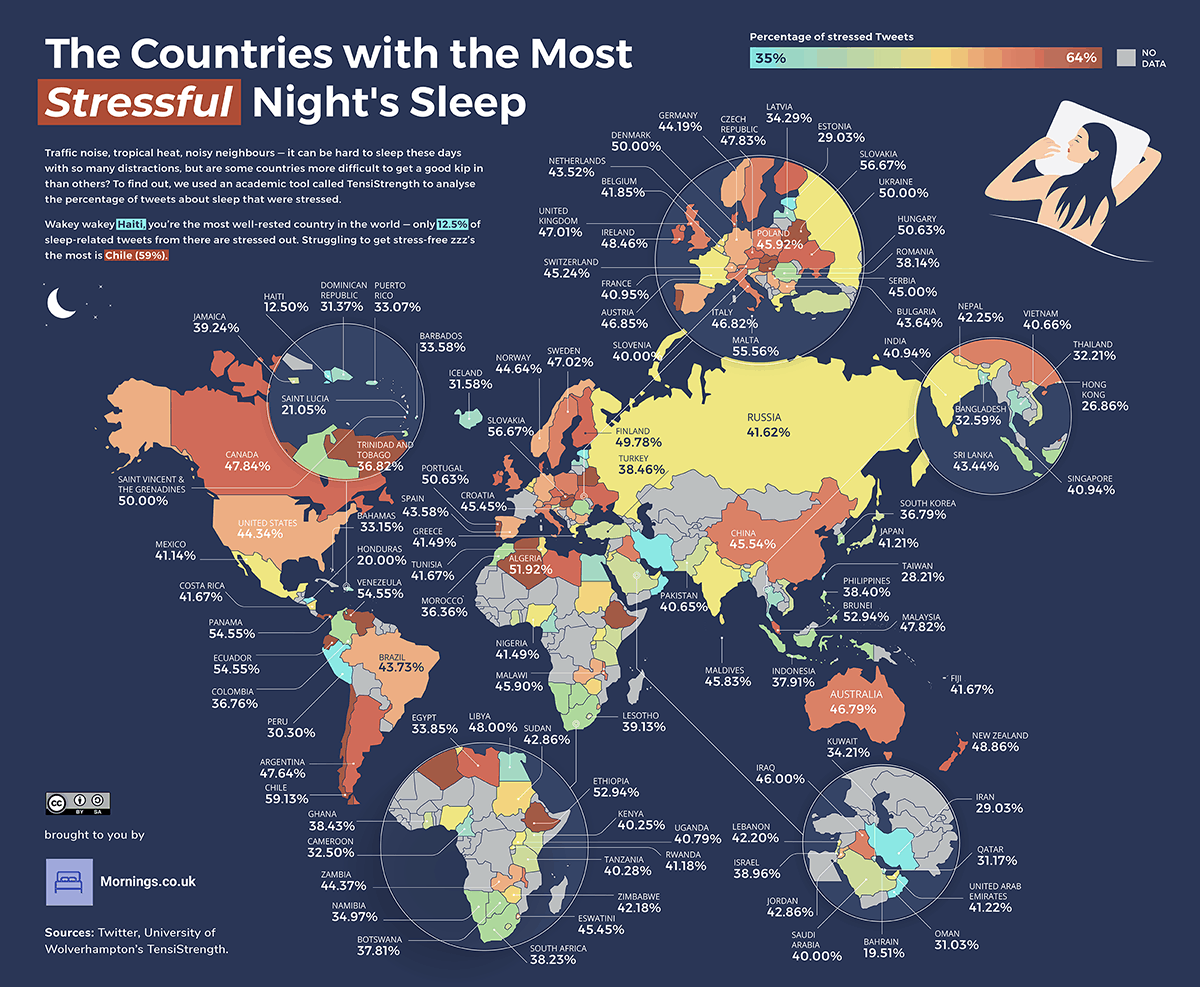
The Countries and Cities With the Most Stressful Night’s Sleep

From zomasleep.com

At what point in your sleepless night do you give in and reach for your phone?

Kept awake by discomfort, traffic noise, or a troubled mind, you want to scream about it to somebody. But your partner and neighbours wouldn’t like that. So you pick up your phone. Maybe you’ll scroll the news and Instagram for a while. But first, you need to tweet out your frustration.

Insomnia is stressful. In fact, there is a long history of sleep deprivation used as literal torture. As early as the 19th century, sleep scientists linked insomnia with “severe psychic disturbances such as delirium, hallucinations and emotional disruption” (yep, sounds like Twitter). But even today, poor sleep continues to contribute to health problems and even death.

Sleep and sleeplessness are universal needs – but some countries have worse nights than others. Morning Life decided to see where in the world sleeplessness causes the most stress. We used a research tool called TensiStrength to measure the stress levels in sleep- and snoring-related tweets from around the world.

Key Findings

  • Chile is the country with the most stressful night’s sleep, with 59.13% of sleep-related tweets exhibiting stress.
  • The world’s most insomnia-stressed city is Rochester, New York, with 55.21% stress rate.
  • Alabama is the American state with the highest sleep stress rate: 63.43%.
  • Liverpool and Manchester in the UK are cities with the second and third most insomnia-stressed citizens in the world (53.92% and 51.21% respectively).
  • However, the UK as a whole is number 24 in the world for stressful sleeping, with a 47.01% stress rate.

England’s Northwest Cities Rival New York for Sleeplessness

British and American cities dominate the top 10 worst cities for sleep. “Hey body it’s cool you wanted to go to bed by 9,” remarks one resident of Rochester, New York, “but getting up at 1:15 and not letting me go back to sleep is rude.”

Rochester (55.21%) is home to the world’s most stressed insomniacs – but the northwest of the UK is wide awake and tweeting, too. Liverpool and Manchester battle for second-place honours, perhaps kept awake by the echo of the industrial revolution, bright lights and all. However, there could be another cause: “I snore so loud you’d just punch me in the face and pretend I was having a bad dream,” declares one Mancunian.

And the sleepy end of the table? Cairo is the third least sleep-stressed city in the world, despite once ranking as the “most 24-hour” of all cities. Indeed, African cities are snoozing up against American ones in most of the top spots. The exception is the world’s most peacefully sleeping city: Cali, Colombia, with a stress rate of just 33.93%. “woke up feeling grateful,” says resident @VirtualJoey.

Latin America Sleeps Unsoundly, Caribbeans Take It Easy

Cali may have the happiest sleepers, but Latin America, in general, is finding it a struggle. Chile is the country with the most stressed insomniacs in the world, and Venezuela, Panama, and Ecuador aren’t far behind. “me: I will sleep at a normal hour tonight!” begins @ARealBigYawn in Chile, concluding: “my body: no. suffer.”

Caribbean, Asian, and Middle-Eastern countries form the snooziest regions on our map. Haiti is the least stressed about sleep by quite a jump – only 12.5% of Haitian tweets are stressed, compared to 19.51% for second calmest Bahrain. It’s not all easy, though: “slept at 12 tonight as an attempt to fix my sleep schedule,” says @fadely195 in Bahrain, “and here i am tweeting at 2 45 am.”

And the UK? Of 108 countries with available data, the UK is the 24th most stressed, according to Twitter. But the bedroom is not the only place where sleep must be grappled with: “Fighting your sleep in church is a different kinda fight ðŸ˜­,” declares Londoner @Jaytheofficialx.

Alabama Is Tired-Tweeting More Than Any Other State

The east coast/west coast divide is pretty even when it comes to stressing about sleep. However, CDC research shows that sleeplessness is a particularly east coast phenomenon. In other words, the likes of Washington, Idaho, and Montana are stressing for no good reason (though Nevada’s high stress rate is genuinely linked to a low sleep rate).

Alabama, America’s most stressed state at bedtime, is sandwiched between half a dozen of America’s most mellow states. The problem seems to be… other Alabamans. “Had to pop 3 Benadryl to fall asleep last night because of my mom and dad’s snoring,” moans one local. 

How to Pour a “Delicious Bath of Oblivion”

“I would gladly exchange city life for that of the lonely backwoodsman,” wrote Albert Kimball, dentist, journalist, and noted insomniac in 1902. “[T]o purchase that blessed repose which nature vouchsafes to the weary, healthy body and the calm, unheated brain; the slumber of the tired child who drops into the delicious bath of oblivion as his head sinks into the soft embrace of the pillow.”

Sounds good? Today, you don’t need to retrain as a lonely backwoodsman to get a good night’s sleep in the city. Firm windows, a well-selected mattress, and your favourite pillows can recreate that delicious bath of oblivion.

METHODOLOGY & SOURCES

We compiled a set of terms related to sleep, e.g.: sleep, slept, nap, woke up. Using these terms we pulled tweets using Twitter API and ran geotagged tweets through TensiStrength. We labelled tweets with a stress level from -2 to -5 as stressed, while tweets with stress levels equal to -1 were deemed not stressed. We then calculated the percentage of stressed tweets about sleep in every country, state and city. Data was collected in June 2021.

This article is for informational purposes and should not replace advice from your doctor or other medical professional.

https://zomasleep.com/uk/blog/most-stressful-nights-sleep?srsltid=AfmBOoraL8S16Do2amTlDRUKU4-lprMdOxrUnoapFqODbrvpishsmq0_ 

Saturday, 2 August 2025

Early bird or night owl? Don’t switch cold turkey

From news4jax.com

Are you an early bird or a night owl? Well, about 60% of people are in the middle with only slight preferences either way.

But we live in an early bird society, as most work happens during the day. And a 2024 Gallup poll found that 57% of adults report needing more sleep.

Whether you start a new school or a new job, your sleep schedule could be very different than your current one. So how do you change it?

“If you wanna shift your schedule, slower is better,” said Dr. Brian Chen, a sleep specialist at the Cleveland Clinic Sleep Disorders Center. “Just plan ahead for if you know something like, school is about to start in this many weeks and I’m falling asleep at this time, but I have to be falling asleep four hours earlier. Well, you gotta start shifting four weeks ahead of time.”

If you shift your sleep schedule cold turkey, you put yourself at risk for sleep deprivation.

“There are issues in terms of your heart, in terms of your brain, cognitive deficits later on in life as you’re older and probably insomnia, long-term, chronic insomnia,” explained Chen.

The NIH reports that 86.5% of older adults with insomnia report at least two other chronic illnesses, including cardiovascular disease, hypertension, and AFib. Also, older adults with chronic pain and insomnia experienced worse pain more often. So how do you know how much sleep you need?

“Everybody is a little bit different,” said Chen.

Your baseline depends on your age. Six to 12-year-olds need between nine and 12 hours of sleep, teenagers need eight to 10 hours of sleep, and adults need seven to nine hours of sleep.

Chen says start by tracking how much sleep you get naturally:

“This is usually something you do on vacation. So on vacation, when do you go to bed, when do you wake up?” he told Ivanhoe.

From there, you can create a healthy shift in your schedule, little by little, over several weeks.

If you think just sleeping in on the weekends can offset your sleep debt, you’re wrong.

The Sleep Foundation says that while that may help you feel less sleepy, it doesn’t take away the increased risk of hypertension, Type 2 diabetes, and Alzheimer’s.

If you have serious concerns about your sleep, Chen says you should speak to a sleep specialist.

https://www.news4jax.com/news/local/2025/07/31/early-bird-or-night-owl-dont-switch-cold-turkey/ 

Friday, 1 August 2025

This One Sleep Habit Could Be Secretly Wrecking Your Health

From scitechdaily.com 

New research reveals that irregular sleep patterns, not just how long we sleep, may significantly raise the risk of numerous diseases

A massive new study examining real-world sleep data from over 88,000 UK adults has uncovered striking links between sleep habits and more than 170 diseases. Credit: Shutterstock

A major international study published in Health Data Science has revealed strong links between sleep patterns and the development of 172 different diseases. By examining objective sleep data from 88,461 adults in the UK Biobank, researchers uncovered compelling evidence that consistent sleep routines, including stable bedtimes and circadian rhythms, play a much larger role in long-term health than previously thought.

The research, led by scientists from Peking University and Army Medical University, tracked participants using actigraphy over an average of 6.8 years. The findings showed that poor sleep habits contributed to more than 20 percent of the risk for 92 diseases.

Among the most striking results, going to bed after 12:30 a.m. (irregular bedtime) was associated with a 2.57 times greater risk of developing liver cirrhosis. Additionally, low interdaily stability, a sign of disrupted sleep-wake cycles, was linked to a 2.61 times higher risk of gangrene.


Comprehensive Sleep Related Disease Spectrum Throughout Human Body

The six circular icons at the top represent sleep traits: nocturnal sleep duration and onset timing, relative amplitude, inter-daily stability, sleep efficiency, and waking numbers. The icons surrounding human body display diseases of different systems. The number next to the icons represents the percentages of disease types related to sleep accounted for the whole types of disease in the very system. The study identified 172 diseases correlated with sleep traits. For these diseases, an average of 23.01% of disease burden can be attributed to sleep traits. Credit: Wang Shengfeng (Peking University)


Rethinking Long Sleep: Myth vs. Reality

Importantly, the study challenges previous claims that “long sleep” (≥9 hours) is harmful. While subjective reports have linked long sleep to stroke and heart disease, objective data revealed this association in only one disease. Misclassification may be to blame: 21.67% of “long sleepers” actually slept less than 6 hours, suggesting that time spent in bed is often confused with actual sleep time.

“Our findings underscore the overlooked importance of sleep regularity,” said Prof. Shengfeng Wang, senior author of the study. “It’s time we broaden our definition of good sleep beyond just duration.”

The team confirmed several associations in U.S. populations and identified inflammatory pathways as a possible biological link. Future research will explore causality and assess the impact of sleep interventions on chronic disease outcomes.

Reference: “Phenome-wide Analysis of Diseases in Relation to Objectively Measured Sleep Traits and Comparison with Subjective Sleep Traits in 88,461 Adults” by Yimeng Wang, Qiaorui Wen, Siwen Luo, Lijuan Tang, Siyan Zhan, Jia Cao, Shengfeng Wang and Qing Chen, 3 June 2025, Health Data Science.

https://scitechdaily.com/this-one-sleep-habit-could-be-secretly-wrecking-your-health/